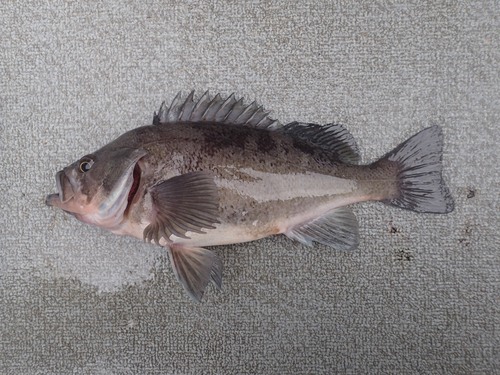
Light Dusky Rockfish
Sebastes variabilis
A social wanderer of the North Pacific kelp forests, the Light Dusky Rockfish is a master of the mid-water reefs. With its subtle earthy tones and large, soulful eyes, it is a hallmark species of the cold, rugged waters of the Pacific Northwest.
Quick Identification
Size
Typically 30-45 cm (12-18 inches), reaching a maximum length of 53 cm (21 inches) and weighing up to 2.3 kg (5 lbs).
Colors
Uniformly light gray-brown to greenish-brown body with a distinctly lighter, often creamy-white belly; lacks the dark spotting found in similar rockfish species.
Key Features
- Large eyes adapted for deep-water light
- 13 sharp spines on the dorsal fin
- Straight or slightly slanted trailing edge on the anal fin
- Uniform brownish coloration without heavy mottling
When You’ll See Them
Geographic range
Where Does the Light Dusky Rockfish Live?
Native to the cold, nutrient-dense waters of the North Pacific Ocean, the Light Dusky Rockfish is found along the continental shelf from the Bering Sea and Aleutian Islands through the Gulf of Alaska. Its range extends southward through the coastal waters of British Columbia, reaching as far as central Oregon in the United States. They are most abundant in the northern parts of this range where rocky underwater terrain provides ample hiding spots.
Basemap © OpenStreetMap contributors
Behavior
Unlike more territorial bottom-dwelling rockfish, the Light Dusky is more of a wanderer, following currents and plankton blooms. They show a cautious curiosity toward divers and underwater equipment, often maintaining a set distance while watching with their large, sensitive eyes. In the presence of predators like seals or larger fish, the school will quickly retreat into the protection of rock crevices or thick kelp canopies.
EverydayEarth exclusive
Camera Tips
To capture the Light Dusky Rockfish on camera, you will need a waterproof underwater camera or a trail camera housed in a specialized submersible case. The most effective placement is near a 'structure'—aim your lens at a rocky outcrop or the edge of a kelp forest at a depth of 15 to 40 feet. Ensure the camera is weighted or mounted to a heavy base to prevent it from shifting with the tides. Positioning the lens horizontally or with a slight upward tilt helps capture the silhouettes of the school against the shimmering surface light.
Attracting these fish is best achieved through scent. Use a small mesh bag or a perforated PVC tube filled with oily bait, such as crushed herring or sardines, and secure it about 3 to 5 feet in front of the lens. The Light Dusky Rockfish is naturally curious about new scents in the water column. Once one fish approaches the bait, the social nature of the species usually draws the entire school into the frame, providing an excellent opportunity for high-quality video or a series of burst photos.
Visibility is the biggest hurdle for underwater photography. For the clearest images, deploy your camera on a sunny day during 'slack tide' when water movement is at its minimum, which reduces the amount of floating silt and debris (marine snow) that can trigger the sensor or blur the image. If your camera has adjustable settings, use a high shutter speed and turn off built-in flashes, as artificial light often reflects off particles in the water, creating a 'snowstorm' effect in your footage.
Similar Species
Species that look similar or are commonly confused with Light Dusky Rockfish.
Frequently Asked Questions
Record Light Dusky Rockfish at your habitat
Connect a camera to start building your own species record — AI identifies every visitor automatically.