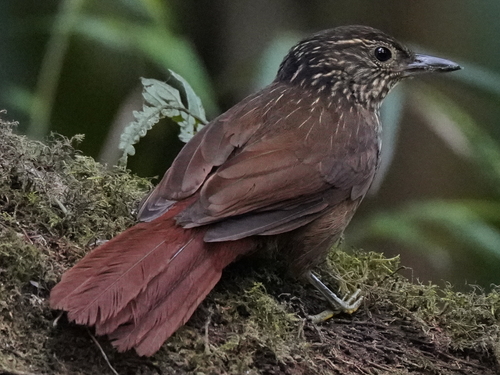
Lineated Foliage-gleaner
Syndactyla subalaris
A methodical detective of the cloud forest, the Lineated Foliage-gleaner uses its powerful bill to uncover life hidden within the moss and mist of the Andes.
Quick Identification
Size
17–19 cm (6.7–7.5 in) in length; 26–40 g (0.9–1.4 oz) in weight
Colors
Olive-brown upperparts with prominent buffy-white streaks; rufous wings and tail; buffy-white throat and heavily streaked underparts. Sexes are similar in appearance.
Key Features
- Bold buffy-white longitudinal streaks on head and back
- Bright rufous wings and long, graduated tail
- Heavy, slightly upturned bill with a pale lower mandible
- Frequently seen foraging in a 'creeper-like' fashion on mossy limbs
When You’ll See Them
Geographic range
Where Does the Lineated Foliage-gleaner Live?
This bird is a native specialist of the Neotropical highlands, found primarily in the mountain ranges of Central and South America. Its range extends from the Cordillera Central of Costa Rica and Panama down through the Andes of Colombia, Ecuador, and Peru, as well as the coastal mountains of Venezuela. It lives exclusively in high-elevation tropical environments where moisture is abundant year-round.
Basemap © OpenStreetMap contributors
Behavior
The Lineated Foliage-gleaner is a quintessential cloud forest specialist, known for its methodical and acrobatic foraging style. It spends much of its time in the forest mid-story, exploring epiphytes, bromeliads, and clusters of dead leaves. Unlike many smaller songbirds that flit rapidly, this species moves with a deliberate, searching pace, often hanging upside down or stretching to reach into deep crevices where insects hide.
While they can occasionally be found in pairs, they are most frequently encountered as vital members of mixed-species foraging flocks. They often travel alongside woodcreepers and other ovenbirds, contributing to the flock's collective vigilance. Despite being relatively common in their range, they are often heard before they are seen, emitting a loud, rhythmic series of 'chip' notes that echo through the misty canopy.
EverydayEarth exclusive
Camera Tips
To capture the Lineated Foliage-gleaner, place your AI-powered camera in the mid-story of the forest rather than on the ground. Look for horizontal, moss-covered branches that are approximately 2 to 4 meters high. This species is attracted to 'tangles'—areas where vines, bromeliads, and fallen debris create complex structures. Aiming your camera at a large, prominent bromeliad or a cluster of trapped dead leaves significantly increases your chances of a sighting.
Because these birds inhabit high-humidity cloud forests, condensation is your biggest enemy. Use a camera housing with a rain shield and apply an anti-fog treatment to the lens. Set your camera to a fast trigger speed and high-resolution burst mode; foliage-gleaners move their heads rapidly while searching for prey, and a single still shot often results in a motion-blurred beak.
While they do not visit standard seed or nectar feeders, you can lure them toward a camera site by maintaining a natural-looking birdbath on an elevated platform or stump. They are most active in the early morning as the mist begins to rise and again in the late afternoon. If you are in a backyard setting bordering a forest, keeping your 'wild' areas messy with native epiphytes and avoiding the removal of dead leaves from tree crotches will encourage them to venture closer to your lens.
Similar Species
Species that look similar or are commonly confused with Lineated Foliage-gleaner.
Frequently Asked Questions
Record Lineated Foliage-gleaner at your habitat
Connect a camera to start building your own species record — AI identifies every visitor automatically.