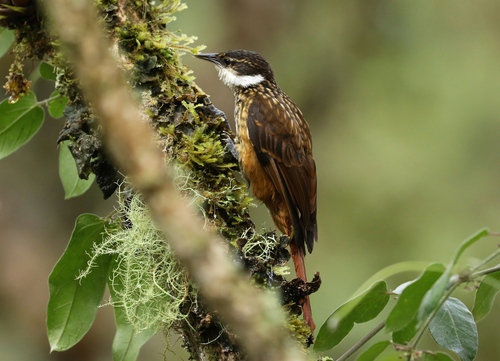
Streaked Tuftedcheek
Pseudocolaptes boissonneautii
Meet the acrobat of the Andes, a charming bird known for its puffy white cheeks and its obsession with exploring high-altitude epiphytes. The Streaked Tuftedcheek is a splash of rufous color in the misty cloud forests of South America.
Quick Identification
Size
20-22 cm (8-8.5 inches) in length; weighs between 37-62g (1.3-2.2 oz)
Colors
Brownish-buff body with prominent creamy-white or buff cheek tufts; bright rufous-red tail and rump; dark crown with pale streaks.
Key Features
- Distinctive puffy white or buff cheek tufts
- Bright rufous tail used for balance while climbing
- Heavy pale streaking on a dark brown crown and back
- Specialized curved bill for probing epiphytes
When You’ll See Them
Geographic range
Where Does the Streaked Tuftedcheek Live?
Native to the South American continent, the Streaked Tuftedcheek is a quintessential resident of the Andes Mountains. Its range stretches across the high-elevation tropical forests of Venezuela, Colombia, Ecuador, Peru, and northern Bolivia. These birds are specialized mountain dwellers, favoring the lush, mist-shrouded cloud forest belts where high humidity supports the dense epiphytic growth they rely on for survival.
Basemap © OpenStreetMap contributors
Behavior
The Streaked Tuftedcheek is a high-energy acrobat of the cloud forest, renowned for its specialized foraging style. Unlike many of its relatives that hunt on the ground, this bird is an epiphyte specialist, spending its days hanging upside down and clinging to mossy branches to investigate the centers of bromeliads and orchids for hidden prey.
While they are often seen alone or in pairs, they are highly social members of mixed-species foraging flocks. You will often find them traveling alongside woodcreepers and tanagers, acting as one of the more vocal and visible members of the group. They are quite bold and can be surprisingly approachable if you remain still, as they are often too preoccupied with their intensive search for food to notice onlookers.
EverydayEarth exclusive
Camera Tips
To successfully capture the Streaked Tuftedcheek on camera, you must think vertically. These birds rarely descend to the ground, preferring the mid-to-upper canopy and sub-canopy of the forest. If your property borders an Andean cloud forest, mount your camera 10 to 15 feet high on a sturdy, mossy branch. Aim the lens specifically at large clusters of bromeliads or thick mats of epiphytes, as these are the bird's primary 'grocery stores' and where they spend the most time stationary.
While they are not attracted to traditional seed feeders, they are highly inquisitive and frequently visit water sources. A elevated birdbath or a slow-dripping water feature positioned near a mossy limb can be an excellent lure. Because cloud forests are often dimly lit by mist and heavy canopy cover, use a camera with a high-quality sensor and fast trigger speed. These birds are constantly on the move, flicking their bright rufous tails and darting between mossy clumps, so a slow camera will only capture a blur.
Set your camera to take short bursts of photos or high-definition video rather than single shots. This increases your chances of capturing their unique 'puffed out' cheek tufts or the moment they pull a grub from a bromeliad. Early morning is the most productive time, just as the mountain mist begins to move, as this is when they are most active within mixed-species flocks.
Similar Species
Species that look similar or are commonly confused with Streaked Tuftedcheek.
Frequently Asked Questions
Record Streaked Tuftedcheek at your habitat
Connect a camera to start building your own species record — AI identifies every visitor automatically.