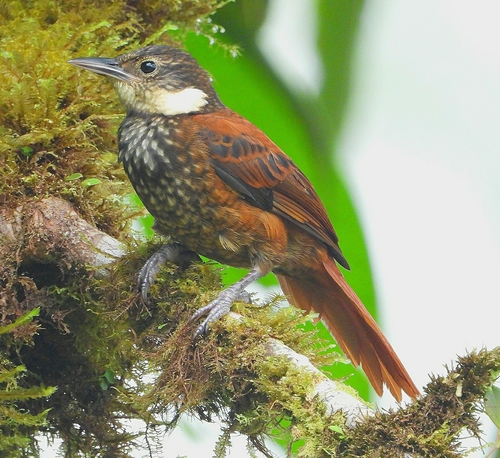
Pacific Tuftedcheek
Pseudocolaptes johnsoni
A master of the misty Chocó cloud forests, the Pacific Tuftedcheek is a specialist of the canopy, known for its flamboyant white facial feathers and its relentless search for prey among the bromeliads.
Quick Identification
Size
20–21 cm (7.9–8.3 in) in length; 45–55 g (1.6–1.9 oz)
Colors
Rich rufous-brown upperparts and bright chestnut tail; striking buffy-white 'tufts' on the cheeks; ochre-buff underparts with faint streaking.
Key Features
- Large, fan-like buffy-white cheek tufts
- Long, stiff chestnut tail used for bracing
- Heavily streaked dark crown and mantle
- Distinctive posture while probing epiphytes
When You’ll See Them
Geographic range
Where Does the Pacific Tuftedcheek Live?
Native to the South American continent, the Pacific Tuftedcheek is a specialist of the Chocó bioregion. This bird lives within a narrow latitudinal band on the western slopes of the Andes mountains, spanning from western Colombia into northwestern Ecuador. It is a regional endemic that relies on the consistent moisture and high-altitude mists typical of these Pacific-facing slopes.
Basemap © OpenStreetMap contributors
Behavior
The Pacific Tuftedcheek is a specialized and energetic inhabitant of the moss-drenched cloud forests. It is most famous for its acrobatic foraging style, often seen clinging upside down or sideways to mossy limbs while it methodically investigates the centers of bromeliads and thick mats of epiphytes. It uses its sturdy, slightly decurved bill like a probe to flush out hidden prey from the moisture-rich vegetation of the canopy.
While they are sometimes seen in pairs, they are more commonly encountered as 'nuclear' members of mixed-species foraging flocks. These flocks move through the forest in a wave of activity, with the Tuftedcheek often leading the way among the mid-to-upper levels of the trees. They are generally bold and focused on their tasks, making them relatively easy to observe once located, though their constant movement requires a quick eye.
EverydayEarth exclusive
Camera Tips
To capture the Pacific Tuftedcheek on a trail camera, you must focus on vertical structures. These birds are rarely seen on the ground; instead, mount your camera 10 to 15 feet high on the trunk of a tree heavily laden with moss and bromeliads. Angle the lens downward toward a horizontal branch or a cluster of epiphytes, as this is where they spend the majority of their time probing for food.
Given the high-humidity environment of the Chocó cloud forest, moisture management is critical for your equipment. Use high-quality desiccant packs inside your camera housing to prevent lens fogging and consider a secondary waterproof roof to deflect the near-constant mist. Because these birds move with quick, jerky motions, set your camera to its fastest shutter speed and utilize a multi-shot 'burst' mode to ensure at least one frame captures the cheek tufts in sharp focus.
If you are setting up a camera near a dwelling or research station, you can encourage visits by maintaining 'micro-habitats.' A fallen log covered in native mosses and ferns, placed within view of a camera in a shaded area, can act as a natural lure for the insects they hunt. Avoid traditional birdseed, as it will not attract this species. Early morning light provides the best opportunity for clear shots, as the forest often becomes too misty for crisp photography by mid-afternoon.
Similar Species
Species that look similar or are commonly confused with Pacific Tuftedcheek.
Frequently Asked Questions
Record Pacific Tuftedcheek at your habitat
Connect a camera to start building your own species record — AI identifies every visitor automatically.