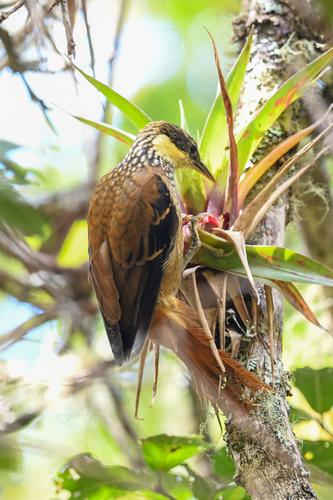
Buffy Tuftedcheek
Pseudocolaptes lawrencii
A spectacular acrobat of the misty highlands, the Buffy Tuftedcheek is a bromeliad specialist known for its unique 'mutton-chop' facial feathers and bold personality.
Quick Identification
Size
20 cm (7.9 in) long; weighs between 48–61 g (1.7–2.1 oz)
Colors
Rich rufous-brown back and tail; dark brown crown with buff streaks; creamy-buff throat and distinctive fan-like cheek tufts; buffy-olive breast with pale longitudinal streaks.
Key Features
- Prominent fan-like buffy cheek tufts
- Bright rufous wings and long, stiff tail
- Heavily streaked dark crown and mantle
- Stout, slightly decurved blackish bill
- Acrobatic foraging posture often hanging upside down
When You’ll See Them
Geographic range
Where Does the Buffy Tuftedcheek Live?
The Buffy Tuftedcheek is a regional specialty of Central America, found exclusively in the highlands of the Isthmus. Its native range is concentrated in the mountain chains of Costa Rica and western Panama, specifically inhabiting the Cordillera Central and the Talamanca range. It is a true montane specialist, restricted to these misty peaks and absent from the surrounding lowlands.
Basemap © OpenStreetMap contributors
Behavior
The Buffy Tuftedcheek is an energetic and charismatic member of the ovenbird family, renowned for its acrobatic foraging style. It is a specialist of the canopy and mid-story, where it spends much of its time investigating epiphytes. It is famously associated with bromeliads, using its strong bill to pry apart leaves and toss moss aside in search of hidden prey. Unlike many of its more secretive relatives, the Tuftedcheek is quite bold and often allows for close observation as it busily works through the foliage.
Socially, these birds are often the 'sentinels' or core members of mixed-species foraging flocks. You will frequently find them traveling alongside tanagers, woodcreepers, and warblers. They communicate with a series of sharp, 'hiccuping' notes and a loud, rattling song that can be heard echoing through the misty cloud forests. While they are usually seen in pairs, they maintain large territories and are highly resident, staying in the same high-altitude forests year-round.
EverydayEarth exclusive
Camera Tips
To successfully capture the Buffy Tuftedcheek on an AI-powered camera, placement is everything. These birds are arboreal specialists, so mounting your camera at eye level or higher (2-5 meters) is essential. Focus on 'hotspots' like large, moss-covered horizontal limbs or clusters of mature bromeliads. Since they are attracted to the complex structures of epiphytes, a camera aimed at a particularly lush branch in the mid-story is far more likely to get a hit than one facing an open clearing.
While they don't visit traditional seed feeders, they are extremely curious and attracted to water. In high-altitude gardens, a dripping water feature or a birdbath placed near the forest edge can be a highly effective lure, especially during the drier months from January to April. Ensure your camera is set to a high trigger speed; Tuftedcheeks move with quick, jerky motions and can enter and exit the frame in seconds.
Lighting in the cloud forest is notoriously difficult due to frequent mist and heavy canopy shade. If your camera allows, use a higher ISO setting or a gentle fill flash to help bring out the detail in their buffy 'tufts' and streaked chest. Video mode is highly recommended for this species, as it captures their unique 'hiccuping' vocalizations and the way they flare their neck feathers while calling, which is a spectacular behavior to see on playback.
Similar Species
Species that look similar or are commonly confused with Buffy Tuftedcheek.
Streaked Tuftedcheek
Nearly identical in appearance but restricted to the Andes mountains in South America; the Buffy Tuftedcheek is only found in Central America.
Streaked Xenops
Much smaller with a noticeably upturned bill and lacks the large, fan-like buffy cheek feathers.
Lineated Foliage-gleaner
Has a similar streaked appearance but lacks the distinctive pale cheek tufts and has a different foraging style.
Frequently Asked Questions
Record Buffy Tuftedcheek at your habitat
Connect a camera to start building your own species record — AI identifies every visitor automatically.