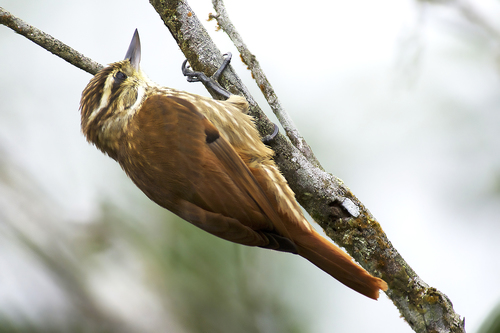
Streaked Xenops
Xenops rutilans
Meet the Streaked Xenops, the tiny, acrobatic forest gymnast known for its bold 'mustache' and gravity-defying foraging. This energetic member of the ovenbird family brings a dash of high-altitude charm to backyard cameras across the New World tropics.
Quick Identification
Size
Length: 4.7 in (12 cm); Weight: 0.35–0.53 oz (10–15 g)
Colors
Olive-brown upperparts and buffy-white underparts; both heavily streaked with black and dark brown. Features a prominent white malar (cheek) stripe and white eyebrow.
Key Features
- Distinctive wedge-shaped, slightly upturned bill
- Heavy dark streaking across the entire breast and crown
- Bold white 'mustache' stripe
- Acrobatic, nuthatch-like climbing behavior
When You’ll See Them
Geographic range
Where Does the Streaked Xenops Live?
This charismatic little bird is native to the Neotropics, spanning a massive range from the highlands of Costa Rica and Panama into South America. It is found throughout the Andes from Venezuela and Colombia down to Bolivia and northwestern Argentina, as well as in the Atlantic forests of Brazil and parts of Trinidad. It is a permanent resident across its range, preferring the lush, insect-rich environments of humid mountain forests.
Basemap © OpenStreetMap contributors
Behavior
The Streaked Xenops is the gymnast of the bird world, often seen hanging upside down or clinging to the underside of branches as it searches for food. Unlike woodpeckers that use their tails for support, this agile bird relies on its strong feet to navigate the outer canopy and mid-level branches of the forest. It is a social creature, often joining mixed-species foraging flocks where it benefits from the 'safety in numbers' while moving through the trees.
When foraging, it uses its unique upturned bill to pry into rotting wood or dead twigs, often making a distinct tapping sound that can help observers locate it. While it is generally shy around humans, it is not particularly disturbed by quiet observers, making it a rewarding subject for patient backyard birdwatchers living near forested corridors.
EverydayEarth exclusive
Camera Tips
To capture the Streaked Xenops on camera, focus your efforts on the vertical structures in your yard. Unlike ground-feeding birds, the Xenops is almost always on the move along tree trunks and thin, decaying branches. Mount your AI camera at chest height or higher, aimed specifically at a 'high-traffic' area like a weathered branch or a vine tangle. Because they are attracted to dead wood for foraging, placing a few safe, untreated dead logs or 'snags' in the camera's field of view can significantly increase your chances of a sighting.
While these birds aren't traditional seed-eaters, they are drawn to the activity of mixed-species flocks. Setting up your camera near a general bird bath or a suet feeder (which mimics the protein-rich larvae they seek) can lure them into range. Angle your camera slightly upward to catch their acrobatic underside-clinging behavior, which is their most distinctive pose. Ensure your shutter speed is set to a fast interval, as their movements are quick and jerky.
Lighting is crucial in the dense, shaded habitats these birds prefer. Position your camera to avoid heavy backlighting from the sky, which can turn the bird's detailed streaks into a dark silhouette. The best footage usually occurs in the early morning hours when the light is soft and the birds are most active. If using a trail cam, a high-sensitivity PIR (passive infrared) setting is recommended to trigger the shutter for such a small, fast-moving subject.
Similar Species
Species that look similar or are commonly confused with Streaked Xenops.
Frequently Asked Questions
Record Streaked Xenops at your habitat
Connect a camera to start building your own species record — AI identifies every visitor automatically.