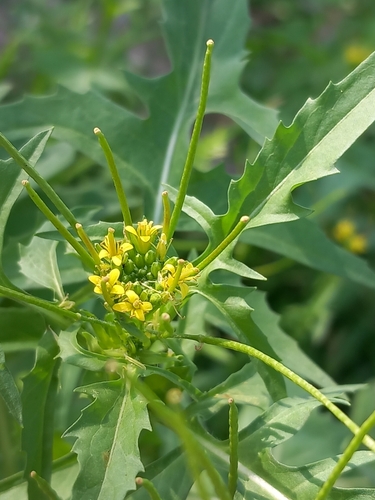
London rocket
Sisymbrium irio
Named for its rapid emergence after the Great Fire of London, this resilient mustard plant is a herald of spring. Its bright yellow blooms provide a vital first meal for the season's earliest pollinators.
Quick Identification
Size
Typically reaches 30 to 90 cm (12 to 35 inches) in height with seed pods 2.5 to 6.5 cm (1 to 2.5 inches) long.
Colors
Bright green foliage with small, pale yellow four-petaled flowers clustered at the stem tips.
Key Features
- Long, narrow seed pods (siliques) that overtop the younger flowers
- Deeply lobed basal leaves in a rosette pattern
- Small yellow flowers with four petals arranged in a cross
- Upright, branching stems that are largely hairless
When You’ll See Them
Behavior
London rocket is a hardy winter annual known for its opportunistic growth. It is often the first plant to emerge in the late winter or early spring, taking advantage of cool temperatures and damp soil before other species begin their growth cycle. It grows rapidly, moving from a low-lying rosette of leaves to a tall, branching flower spike in a matter of weeks.
As a member of the mustard family, it is highly successful at seed production. A single plant can produce thousands of seeds, which are then dispersed by wind or physical contact. While humans often view it as a common weed in gardens and sidewalk cracks, it serves as an important early-season food source for pollinators like hoverflies and bees that emerge before the main spring bloom.
EverydayEarth exclusive
Camera Tips
To capture the growth of London rocket, use a time-lapse setting on your camera. Place the camera on a ground-level mount or a short stake, approximately 12 to 24 inches from the base of the plant. Since London rocket grows vertically quite quickly, ensure your camera angle is wide enough to accommodate its "rocket-like" ascent without needing to be moved every few days.
Because these plants are magnets for early-season pollinators, they are excellent locations to set up a "wildlife station." Focus your camera on the yellow flower clusters at the very top of the stems. Use a high shutter speed or a specific "insect" AI trigger setting to capture the rapid movement of syrphid flies and small bees that visit the flowers. For the best color saturation, aim for mid-morning light when the yellow petals are fully unfurled and the morning dew has just evaporated.
If you are using a motion-triggered camera, be mindful of the wind. The tall, thin stems of London rocket sway easily, which can lead to hundreds of empty triggers. To avoid this, set your camera's sensitivity to a medium level or use a "zone" feature to focus the trigger area specifically on the flower heads rather than the entire moving stem. If you are documenting the plant in a backyard setting, a dark, solid background (like a fence or a potting shed wall) will help the bright green and yellow colors pop in your photos and videos.
Similar Species
Species that look similar or are commonly confused with London rocket.
Frequently Asked Questions
Record London rocket at your habitat
Connect a camera to start building your own species record — AI identifies every visitor automatically.