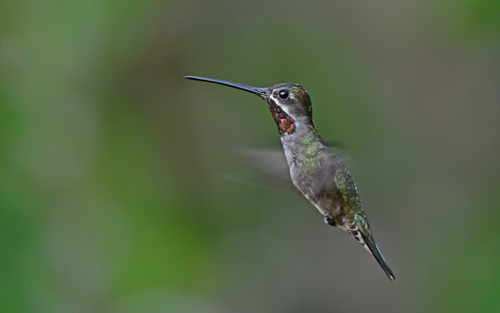
Long-billed Starthroat
Heliomaster longirostris
With its exceptionally long bill and shimmering violet crown, the Long-billed Starthroat is a crown jewel of tropical gardens. This elegant hummingbird is a master of the canopy, visiting backyard feeders with a graceful, calculated presence.
Quick Identification
Size
Length 11-12 cm (4.3-4.7 in); Weight 6-7 g (0.21-0.25 oz)
Colors
Metallic green upperparts; white rump stripe; white moustachial stripe; males feature a glittering violet crown and iridescent rose-red throat.
Key Features
- Exceptionally long, straight black bill
- Bright white moustachial stripe and flank patches
- Glittering violet-blue crown in males
- Dark, slightly forked tail with white tips on outer feathers
When You’ll See Them
Geographic range
Where Does the Long-billed Starthroat Live?
This striking hummingbird claims a vast territory across the Neotropics, stretching from southern Mexico through Central America and deep into South America, reaching as far south as Bolivia and central Brazil. It is also a resident of the Caribbean island of Trinidad. While they are primarily found in humid lowland regions, they are highly adaptable and frequently appear in suburban landscapes and agricultural areas where flowering trees are abundant.
Basemap © OpenStreetMap contributors
Behavior
The Long-billed Starthroat is a sophisticated 'trap-liner,' meaning it follows a specific, memorized route between flowering plants rather than aggressively defending a single territory. This makes them frequent visitors to gardens that offer consistent nectar sources. Unlike smaller, more territorial hummingbirds, starthroats are often observed perching on high, exposed branches between feeding bouts, providing excellent opportunities for identification if your camera is positioned correctly.
They are generally solitary and can be surprisingly quiet compared to the buzzy, vocal nature of other hummers. In backyard settings, they are less likely to engage in the frantic aerial dogfights common to smaller species, preferring to move gracefully through the canopy. While they aren't overly shy, their preference for higher elevations within the garden canopy means they might stay above the typical eye-level of most observers.
EverydayEarth exclusive
Camera Tips
To capture the Long-billed Starthroat on camera, height is your best friend. Unlike many hummingbirds that forage near the ground, starthroats prefer the 'high life,' often perching on bare twigs at the top of the garden canopy. Position your AI-powered camera at least 6 to 10 feet off the ground, ideally angled slightly upward towards a preferred perching branch or a high-hanging nectar feeder. If you have a flowering tree like an Erythrina or a tall Bottlebrush, mount your camera nearby to catch them during their regular trap-lining rounds.
Because of their exceptionally long, straight bills, these birds are perfectly adapted for deep, tubular flowers. If you are using a nectar feeder to lure them, choose one with longer ports or place your camera near native plants with deep corollas to ensure the bird stays in the frame long enough for a clear identification. Since they are active throughout the day but peak in the early morning, ensure your camera's shutter speed is set high enough to freeze the motion of their wings, which beat slower than smaller hummingbirds but still require fast capture speeds for a crisp image.
In a backyard setting, the Long-billed Starthroat is often a visitor rather than a permanent resident of one specific bush. Setting your camera to high sensitivity or using a wider field of view can help catch them as they swoop in from the canopy. If you are using a feeder as a lure, consider adding a thin, horizontal perch near the feeder; starthroats are one of the species more likely to rest between sips, giving the AI and the lens more time to process the brilliant violet crown and the namesake 'starthroat' iridescence.
Similar Species
Species that look similar or are commonly confused with Long-billed Starthroat.
Frequently Asked Questions
Record Long-billed Starthroat at your habitat
Connect a camera to start building your own species record — AI identifies every visitor automatically.