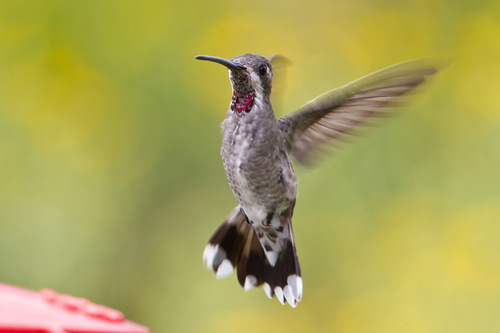
Plain-capped Starthroat
Heliomaster constantii
A graceful giant of the hummingbird world, the Plain-capped Starthroat is a prized sight for backyard birders. Known for its elegant long bill and striking facial stripes, this 'mountain gem' brings a touch of tropical mystery to the garden.
Quick Identification
Size
11-13 cm (4.3-5.1 in) in length; 7-8 grams; wingspan approx. 15-18 cm (6-7 in)
Colors
Bronze-green upperparts, grayish-white underparts; dark gorget (throat) that flashes metallic red in sunlight; distinctive white stripes on face and a white patch on the rump.
Key Features
- Extremely long, slightly decurved black bill
- Bold white stripe behind the eye and at the base of the bill
- Conspicuous white patch on the lower back/rump
- Large, slender silhouette compared to most backyard hummingbirds
When You’ll See Them
Behavior
The Plain-capped Starthroat is a sophisticated 'trapliner,' a term used for hummingbirds that follow a consistent, daily route between various nectar sources rather than aggressively defending a single flower patch. This makes them appear more nomadic and less pugnacious than the smaller, more territorial species like the Rufous Hummingbird. They are calm, elegant fliers that move with a deliberate grace.
In a backyard setting, they are frequently observed perching on high, exposed twigs between feeding bouts. Unlike many hummingbirds that feed almost exclusively on the wing, the Starthroat is quite comfortable landing on a feeder rim or a sturdy flower stem to conserve energy. While they are generally solitary, multiple individuals may gather peacefully at a high-volume food source during the peak of migration.
EverydayEarth exclusive
Camera Tips
To successfully capture a Plain-capped Starthroat on camera, you must account for their unique 'traplining' behavior. They don't hang around one spot all day, so your camera needs to be positioned at a known 'stop' on their route, such as a high-volume nectar feeder or a stand of tubular flowers like Yellow Bells (Tecoma stans) or Ocotillo. Set your camera height between 4 and 5 feet, angled slightly upward to catch the underside of the bird, which helps highlight the gorget and facial stripes.
Lighting is the most critical factor for this species. Their 'plain' cap and dark throat can look muddy or black in the shade. Position your camera so the sun is behind the lens or hitting the bird from the side during the golden hours of morning or late afternoon. This is the only way to capture the brilliant metallic red flash of the throat, which otherwise appears as a dull, dark patch. A high-speed shutter or a video setting of at least 60fps is recommended to freeze the wing motion of this large hummingbird.
Since these birds prefer to perch while scanning their surroundings, look for a bare, protruding twig within 10 feet of your feeder. Placing a secondary camera focused on this 'scout perch' often yields better high-detail stills than a camera at the feeder itself. Because they are attracted to red and yellow, ensure your camera housing is neutral-colored so it doesn't distract them, but keep the bait area brightly colored. If you are in the Southern US, these birds are rare summer visitors, so keep your cameras running consistently from July through September to catch a wandering individual.
Similar Species
Species that look similar or are commonly confused with Plain-capped Starthroat.
Frequently Asked Questions
Record Plain-capped Starthroat at your habitat
Connect a camera to start building your own species record — AI identifies every visitor automatically.