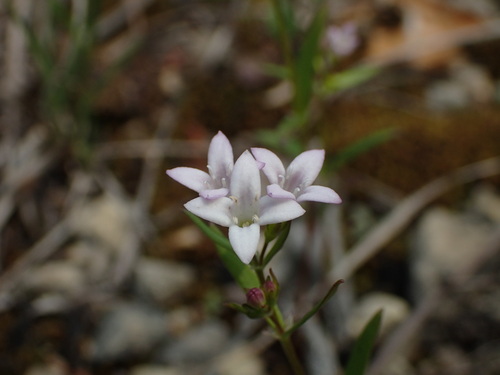
long-leaved bluets
Houstonia longifolia
A hardy summer wildflower that paints dry, rocky woods with a delicate wash of lilac. Long-leaved Bluets are the unsung survivors of the forest floor, thriving in the toughest soils.
Quick Identification
Size
Height: 4 to 10 inches (10–25 cm); flower diameter: 0.25 inches (6 mm)
Colors
Pale purple, lilac, or nearly white flowers; dark green foliage
Key Features
- Four-petaled tubular flowers with pointed tips
- Narrow, linear leaves arranged oppositely on the stem
- Prefers dry, rocky, or sandy soil conditions
- Basal rosette of leaves usually present during the first year
When You’ll See Them
Behavior
Long-leaved Bluets are resilient perennial wildflowers that thrive in challenging environments where many other plants struggle. Unlike their moisture-loving cousins, these bluets are specially adapted to the poor, dry soils of upland woods and rocky barrens. They grow in small, tidy clumps, sending up slender stems that remain relatively upright despite their delicate appearance. They play a vital role in their local micro-ecosystem by providing an early summer nectar source for specialized insects.
Ecologically, these plants are known for their 'heterostyly,' a fascinating reproductive strategy where different individual plants have different flower structures (some with long styles and short stamens, others vice-versa) to ensure cross-pollination. While they aren't 'social' in the animal sense, they often appear in scattered colonies, dotting a forest floor or rocky clearing with a haze of pale lilac. They are non-aggressive and coexist peacefully with native grasses and mosses.
EverydayEarth exclusive
Camera Tips
Capturing the Long-leaved Bluet on a trail camera requires a departure from standard wildlife settings. Because these plants are small and stationary, your primary goal is to document the 'miniature world' surrounding them. Set your camera on a macro or close-focus mode if available. You should mount the camera on a ground-level stake or a 'turtle' mount, positioning the lens just 6 to 12 inches from the flower cluster. Aim for a slightly upward angle to capture the underside of the tubular flowers and the intricate details of the petals against the sky or forest canopy.
To catch the most action, set your camera to 'Time-Lapse' mode with an interval of one frame every 5 to 10 minutes. This will allow you to see the flowers opening in the morning sun and closing as the light fades, a process often too slow for the human eye to appreciate. If your camera has a high-trigger speed, use the 'Video' setting to capture the wide variety of pollinators—such as small sweat bees, beeflies, and skippers—that visit the blooms. These visitors move quickly, so a 30-frame-per-second setting is ideal to avoid motion blur.
Lighting is the most critical factor for these pale flowers. Because they are often found in dappled forest light, harsh mid-day sun can wash out their delicate lilac hues. The best 'hero shots' occur during the 'golden hours' of shortly after sunrise or before sunset when the light is soft and warm. If you are placing a camera in a very shady area, consider using a camera with a high-quality CMOS sensor that handles low light well without needing a heavy flash, which can overexpose the white/purple petals.
Finally, consider the background. Since Long-leaved Bluets often grow in 'messy' environments like dry leaf litter or rocky scree, try to position the camera so there is some distance between the plant and the background objects. This creates a shallow depth of field (bokeh), making the tiny flowers pop against a soft, blurred green or brown background. Check the area for tall blades of grass that might blow in front of the lens, as wind-triggered 'false positives' can quickly fill up your SD card when your target is at ground level.
Similar Species
Species that look similar or are commonly confused with long-leaved bluets.
Frequently Asked Questions
Record long-leaved bluets at your habitat
Connect a camera to start building your own species record — AI identifies every visitor automatically.