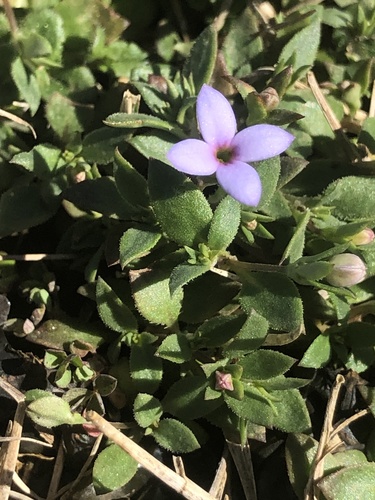
tiny bluet
Houstonia pusilla
One of the first heralds of spring, the tiny bluet transforms ordinary lawns into a shimmering carpet of indigo stars. These miniature wildflowers offer a vital early-season feast for the very first pollinators of the year.
Quick Identification
Size
1-6 inches (2.5-15 cm) tall; flowers are approximately 0.25 inches (6-8 mm) wide
Colors
Deep blue to violet-purple petals with a dark reddish-purple eye and a bright yellow center
Key Features
- Four-petaled star-shaped flowers
- Bright yellow center (eye) surrounded by a dark ring
- Low-growing, mat-forming habit
- Small, opposite oval-shaped leaves
When You’ll See Them
Behavior
The tiny bluet is a charming winter annual and one of the earliest signs of life in the spring. While plants are stationary, they exhibit fascinating daily rhythms; the flowers open wide in response to morning sunlight and tend to nod or close slightly during the night or during heavy overcast periods to protect their pollen.
These wildflowers are highly social in their growth pattern, often appearing in massive drifts that can turn an entire suburban lawn or meadow into a sea of violet-blue. They provide a critical ecological service as one of the first nectar sources available for small solitary bees, bee flies, and gnats emerging from winter dormancy. Because they complete their life cycle quickly before the heat of summer, they are considered spring ephemerals.
EverydayEarth exclusive
Camera Tips
To capture the tiny bluet effectively, you must get your camera down to its level. A standard trail camera mounted on a post will miss them entirely. Use a ground-level stake or a low-profile tripod to position your lens just 2-4 inches off the ground. Because these flowers are so small, a camera with macro capabilities or a close-focusing lens is essential to see the intricate yellow 'eye' at the center of the bloom.
Time-lapse mode is the best way to document this species. Set your camera to take a photo every 10 to 15 minutes starting just before sunrise and continuing until late afternoon. When played back, you will see the 'carpet' of blue appear as the flowers bloom in unison as the sun hits them. This creates a much more dynamic story than a single static image.
If you are using an AI-powered camera designed to trigger on movement, place it near a dense patch of bluets on a calm day. While the plants don't move much, the early-season pollinators they attract—like tiny hoverflies and small bees—will trigger the sensor. Setting your camera to 'High Sensitivity' for motion is necessary because these visitors are often less than half an inch long.
Pay attention to the background and lighting. Mid-morning light is usually the most flattering, offering a soft glow without the harsh shadows of the midday sun. Try to position the camera so that the sun is behind you or to the side, illuminating the vibrant blue petals. Avoid using a flash if possible, as it can wash out the delicate purple-to-blue gradients of the petals.
Similar Species
Species that look similar or are commonly confused with tiny bluet.
Azure Bluet
The Azure Bluet (Houstonia caerulea) is taller, has paler light-blue flowers, and typically grows in more acidic, moist woodland soils rather than open lawns.
Virginia Springbeauty
Springbeauty has five petals with distinct pink stripes, whereas the tiny bluet always has exactly four petals and a yellow center.
Frequently Asked Questions
Record tiny bluet at your habitat
Connect a camera to start building your own species record — AI identifies every visitor automatically.