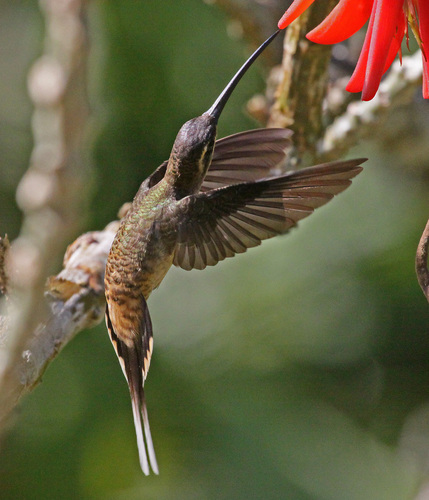
Long-tailed Hermit
Phaethornis superciliosus
With its sweeping, curved bill and iconic white-tipped tail, the Long-tailed Hermit is a master of the tropical understory. This 'trap-lining' specialist brings a touch of prehistoric elegance to the deep shade of the South American rainforest.
Quick Identification
Size
13–15 cm (5–6 in) in length; 4–8 g (0.14–0.28 oz) in weight
Colors
Bronze-green upperparts, buff to ochre underparts, dark brown 'mask' with buff stripes, and white-tipped central tail feathers.
Key Features
- Extremely long, decurved bill
- Elongated white-tipped central tail feathers
- Prominent dark eye-mask with buffy facial stripes
- Large for a hummingbird, with a stocky body
When You’ll See Them
Geographic range
Where Does the Long-tailed Hermit Live?
This elegant hummingbird is a native resident of the lush, tropical landscapes of northern South America. Its primary range encompasses the Guiana Shield—including Guyana, Suriname, and French Guiana—extending into southern Venezuela and the northeastern reaches of the Brazilian Amazon. It is a lowland specialist, rarely wandering far from the humid, shaded cover of the rainforest interior.
Basemap © OpenStreetMap contributors
Behavior
The Long-tailed Hermit is a specialized 'trap-liner,' a behavior where the bird follows a precise, repetitive daily route to visit widely dispersed flowers. Unlike territorial hummingbirds that defend a single patch, the Hermit travels long distances—sometimes several kilometers—ensuring it visits nectar sources that other birds might overlook. This makes them essential pollinators for specialized tropical flora.
In the breeding season, males participate in 'leks,' congregating in the forest understory to sing persistent, squeaky songs. While singing, they frequently flick their long, white-tipped tail feathers to signal to females. Though they spend much of their time in the shaded undergrowth, they are curious birds and can occasionally be seen investigating humans or equipment in their territory with hovering curiosity.
EverydayEarth exclusive
Camera Tips
To capture the Long-tailed Hermit on camera, avoid placing your equipment in direct, harsh sunlight. These birds are specialists of the shaded forest understory and are most comfortable in dappled light. Aim your lens at large, tubular flowers like Heliconia or 'Lobster Claw' plants, which are their favorite nectar sources. Because they are trap-liners, they are creatures of habit; if you see one visit a flower at 8:00 AM, there is a very high probability it will return to that same spot around the same time the following day.
Set your camera at a height of 3 to 5 feet off the ground, as they forage primarily in the lower strata of the forest. Use a high-speed trigger or a video mode with at least 60fps to capture the motion of their wings and the unique flicking of their long tails. A side-profile angle is best for showcasing the dramatic curve of their bill, which is one of their most identifying features.
If you are using a backyard feeder, choose one with long ports or place it near broad-leafed tropical plants to make the Hermit feel secure. They are less aggressive than other hummingbirds, so placing a camera near a feeder in a quiet, shaded corner of a garden is more likely to yield results than placing it in a high-traffic, sun-drenched area. Ensure your focus is sharp on the flower's entrance, as the Hermit will often hover for several seconds while extracting nectar.
Similar Species
Species that look similar or are commonly confused with Long-tailed Hermit.
Frequently Asked Questions
Record Long-tailed Hermit at your habitat
Connect a camera to start building your own species record — AI identifies every visitor automatically.