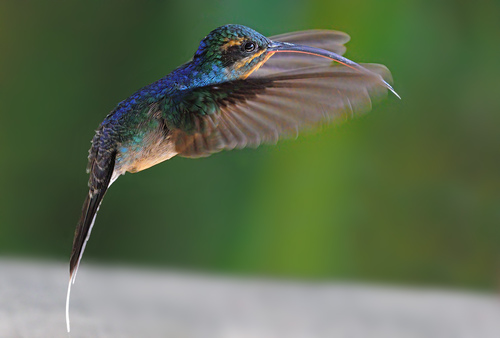
Green Hermit
Phaethornis guy
A shimmering emerald of the cloud forest understory, the Green Hermit is famous for its remarkably long, curved bill and its elegant white-tipped tail. This large hummingbird is a persistent traveler, following ancient nectar routes through the mist-shrouded mountains of the tropics.
Quick Identification
Size
13–15 cm (5.1–5.9 in) in length; 4–7 g (0.14–0.25 oz) in weight
Colors
Metallic green upperparts, dark sooty-grey underparts, and long green tail feathers with conspicuous white tips on the central pair
Key Features
- Extremely long, deeply curved bill with a reddish lower mandible
- Distinctive white-tipped elongated central tail feathers
- Large size compared to typical garden hummingbirds
- Dark facial mask bordered by buffy stripes
When You’ll See Them
Geographic range
Where Does the Green Hermit Live?
Native to the lush tropical regions of Central and South America, the Green Hermit thrives in high-moisture environments. Its range extends from the highlands of Costa Rica and Panama down through the Andean foothills of Colombia, Venezuela, Ecuador, and Peru, as well as the island of Trinidad. It is primarily a bird of the mountain slopes, preferring the mist-covered 'cloud forest' zones over the flat lowlands.
Basemap © OpenStreetMap contributors
Behavior
The Green Hermit is a master of the 'trap-lining' strategy, a sophisticated foraging behavior where the bird follows a precise, recurring route through the forest to visit specific flowers. Unlike many aggressive hummingbirds that defend a single territory, the Green Hermit is a traveler, moving long distances through the understory to sip nectar from scattered plants. They are remarkably consistent, often visiting the same bloom at nearly the same minute every day.
During the breeding season, males are highly social and competitive, gathering in communal display areas known as leks. Here, they perch on low branches and sing a repetitive, squeaky song while vigorously wagging their long tails to impress visiting females. While they are primarily forest-dwellers, they are curious and may approach hikers or observers, though they rarely sit still for long before darting back into the shadows of the canopy.
EverydayEarth exclusive
Camera Tips
To capture the Green Hermit on an AI-powered camera, placement is everything. Because they are trap-liners, they inhabit the forest understory rather than the open sky. Look for large-leafed tropical plants like Heliconia or wild ginger. Position your camera at a height of 3 to 5 feet, aimed directly at a fresh cluster of blooms. Since these birds visit flowers in a predictable sequence, if you see one once, it is likely to return to that exact spot at the same time tomorrow.
Technical settings are crucial for such a fast-moving subject. If your camera allows for manual shutter speed, set it to at least 1/2000th of a second to freeze the wing motion. If you are using a trail camera, use the 'Burst' or 'Photo + Video' mode; the first frame often misses the bird as it darts in, but subsequent frames will catch the hover. Because the Green Hermit prefers the shaded, darker parts of the forest, ensure your camera has a high-quality sensor that can handle low-light conditions without becoming too grainy.
If you are attempting to attract them to a backyard station, standard red hummingbird feeders work, but those with long, perching perches or 'tube' style ports are more natural for their curved bills. Place the feeder in a quiet, shaded corner of your yard near dense foliage rather than in the middle of a lawn. They feel more secure when they have a quick escape route into the bushes. In humid environments, check your lens daily for fogging or condensation, which is common in the cloud forest habitats these birds love.
Similar Species
Species that look similar or are commonly confused with Green Hermit.
Frequently Asked Questions
Record Green Hermit at your habitat
Connect a camera to start building your own species record — AI identifies every visitor automatically.