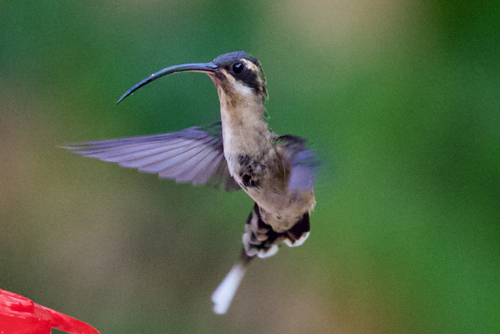
Long-billed Hermit
Phaethornis longirostris
With a magnificent curved bill and elegant tail streamers, the Long-billed Hermit is the 'forest ghost' of the hummingbird world. Unlike its garden-dwelling cousins, this bird is a master of the deep tropical understory.
Quick Identification
Size
15 cm (6 inches) in length; weighs approximately 6 grams (0.21 oz)
Colors
Bronzy-green upperparts, greyish-buff underparts, and a dark mask; male and female look similar though females may have slightly shorter bills
Key Features
- Extremely long, decurved bill with a yellow lower mandible
- Elongated central tail feathers with white tips
- Dark 'bandit' mask through the eyes
- Large, robust body for a hummingbird
When You’ll See Them
Sightings on EverydayEarth
Apr 13, 2026
A lively scene unfolds at the nectar feeder as multiple hummingbirds compete for a spot. A White-necked Jacobin perches prominently, displaying its striking blue head and white tail while feeding. A Long-billed Hermit briefly appears on the left with its characteristic curved beak, while a Blue-chested Hummingbird darts in and out of the frame. Several small insects are also seen buzzing around the feeder ports.
Apr 13, 2026
A bustling scene at the hummingbird feeder features a variety of species. A male White-necked Jacobin is particularly active, often hovering or perching to drink. Several Blue-chested and Snowy-bellied Hummingbirds flit in and out, competing for space. A Long-billed Hermit makes a quick appearance, using its long curved beak to feed briefly before flying off.
Apr 11, 2026
A high-energy scene at the hummingbird feeder with four different species present. A flurry of movement occurs as a male White-necked Jacobin hovers and lands, displaying its white tail. Several Blue-chested Hummingbirds and a Snowy-bellied Hummingbird compete for space on the main tray, while a Long-billed Hermit feeds from the top of the assembly.
Apr 11, 2026
A high-activity moment at the feeder features three different hummingbird species. A Long-billed Hermit uses its specialized curved beak to feed from the left port. Several Blue-chested Hummingbirds zip in and out, while a White-necked Jacobin performs a brief aerial display, fanning its bright white tail feathers to ward off competitors before moving out of view.
Geographic range
Where Does the Long-billed Hermit Live?
The Long-billed Hermit is a tropical specialist native to the Americas. Its range begins in the humid lowlands of central Mexico and stretches south throughout Central America, including hotspots in Costa Rica and Panama. In South America, it is found extensively across the Pacific and Atlantic slopes of Colombia and Ecuador, reaching its southern limit in the northern regions of Peru. It is a permanent resident across its entire range, never migrating but occasionally moving locally based on flower availability.
Basemap © OpenStreetMap contributors
Behavior
The Long-billed Hermit is a fascinating departure from the typical territorial hummingbird. Unlike species that aggressively guard a single flower patch, this bird is a 'trap-liner.' It follows a fixed daily route that can cover several kilometers, visiting widely dispersed nectar-rich plants in a specific sequence. This strategy allows it to exploit flowers that don't produce enough nectar to justify constant guarding but are high in sugar.
Socially, the males are known for their 'leks.' During the breeding season, groups of males congregate in the forest understory to sing persistent, high-pitched songs. They wiggle their long white-tipped tails rhythmically to catch the attention of passing females. Despite their delicate appearance, they are remarkably bold and will often fly quite close to humans if they are standing near a favorite Heliconia plant.
EverydayEarth exclusive
Camera Tips
To capture high-quality footage of a Long-billed Hermit, you need to think like a 'trap-liner.' These birds follow the same path every day. If you spot one visiting a specific flower, set your camera up right there—it will likely return at almost the same time the following day. Focus your lens on long, tubular flowers such as Heliconia, Wild Plantain, or Shrimp Plants, as these are their preferred food sources. Position the camera at chest height (about 3 to 4 feet), as these birds stay low in the understory to avoid wind and predators.
Because hummingbirds move with incredible speed, standard motion triggers can sometimes be too slow, resulting in a video of an empty flower. If your camera has a 'Pre-Roll' feature or a high-speed trigger mode, enable it. Set your video resolution to at least 2K or 4K to capture the fine detail of their iridescent feathers and the white tips of their tail. If you are using a trail camera, a fast shutter speed or high frame rate (60fps or higher) is essential to avoid a blurry image of their wings.
Lighting is your biggest challenge in the dense forest understory. Try to find a flower that receives a 'sun fleck'—a spot where sunlight breaks through the canopy—at a certain time of day. Position your camera so the sun is behind you, illuminating the bird’s face and mask. If your backyard is adjacent to a forest, planting nectar-rich native species will bring them right to your lens, but avoid using red-dye feeders, as these birds prefer the complex structure of natural blooms.
Similar Species
Species that look similar or are commonly confused with Long-billed Hermit.
Green Hermit
The Green Hermit is typically found at higher elevations and has much darker, greener underparts compared to the buffy tones of the Long-billed Hermit.
Little Hermit
Significantly smaller in size with a much shorter bill and less prominent tail streamers.
Bronzy Hermit
Lacks the elongated central tail feathers and has a more uniform bronzy-brown coloration without the sharp facial contrast.
Frequently Asked Questions
Record Long-billed Hermit at your habitat
Connect a camera to start building your own species record — AI identifies every visitor automatically.