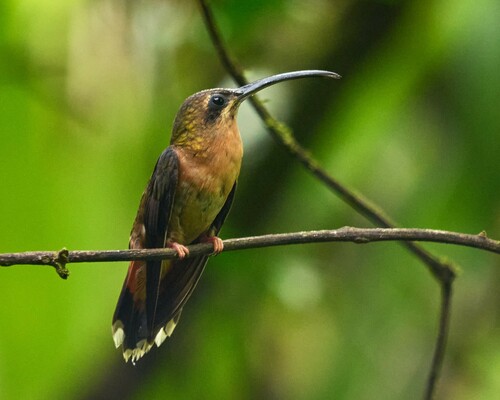
Bronzy Hermit
Glaucis aeneus
A shimmering jewel of the tropical understory, the Bronzy Hermit is a master of the forest circuit. Known for its distinctive curved bill and 'trap-lining' habits, this hummingbird brings a touch of prehistoric grace to the lowland jungles.
Quick Identification
Size
9-10 cm (3.5-4 in) in length; weight approximately 3-7 grams
Colors
Bronzy-green upperparts, pale cinnamon-buff underparts, dusky facial mask, and white-tipped tail feathers. Both sexes appear similar, though females may be slightly smaller.
Key Features
- Strongly decurved (downward-curving) bill
- Metallic bronzy-green crown and back
- Wide, white tips on the outer tail feathers
- Dark mask through the eye area
When You’ll See Them
Geographic range
Where Does the Bronzy Hermit Live?
The Bronzy Hermit is a native resident of the lush tropical corridors of Central and South America. Its geographic range extends from the Caribbean slopes of eastern Honduras through Nicaragua, Costa Rica, and Panama, reaching into the Pacific lowlands of Colombia and northwestern Ecuador. This species is a year-round resident of the humid Neotropics and does not undertake long-distance migrations, remaining within its forest habitat as long as flowering plants are available.
Basemap © OpenStreetMap contributors
Behavior
The Bronzy Hermit is a classic 'trap-liner,' a foraging strategy where the bird follows a consistent, long-distance route between widely dispersed nectar sources. Unlike more aggressive hummingbird species that defend a single territory or feeder, the Bronzy Hermit is relatively non-territorial and solitary, quietly moving through the forest understory in a predictable circuit throughout the day.
These birds are primarily understory specialists, rarely seen high in the canopy. They have a characteristic flight pattern, often hovering with their tail cocked upward while feeding. In terms of social interaction, they are generally shy and will quickly zip away into dense foliage if disturbed, making them a rewarding but challenging subject for wildlife observers and photographers.
EverydayEarth exclusive
Camera Tips
To successfully capture a Bronzy Hermit on your trail camera, you must focus on their 'trap-line' behavior. These birds visit the same flowers at roughly the same time every day. Identify native tubular flowers like Heliconia, wild ginger, or passionflower in your area and mount your camera on a nearby post or tree. Because these birds stay low, position your camera only 2 to 4 feet off the ground, angled slightly upward toward the bloom.
Hummingbirds are incredibly fast, so standard motion triggers often fail or capture only a blur. Use a camera with a high-speed trigger (less than 0.2 seconds) or, better yet, set your device to record 4K video at 60 frames per second. This allows you to review the footage in slow motion and extract high-resolution stills. If your camera has a 'time-lapse' mode with short intervals, this can also be an effective way to catch them if the motion sensor isn't sensitive enough for their small body size.
Lighting is your biggest challenge in the shaded understory. Try to place your camera in a spot where dappled morning light hits the flowers, as the natural light will bring out the metallic bronze shimmer of their feathers. Avoid using heavy white-light flashes at night or in deep shade, as this can startle the bird; instead, rely on high ISO settings or subtle infrared if your camera supports a 'day-only' mode for color accuracy.
Similar Species
Species that look similar or are commonly confused with Bronzy Hermit.
Frequently Asked Questions
Record Bronzy Hermit at your habitat
Connect a camera to start building your own species record — AI identifies every visitor automatically.