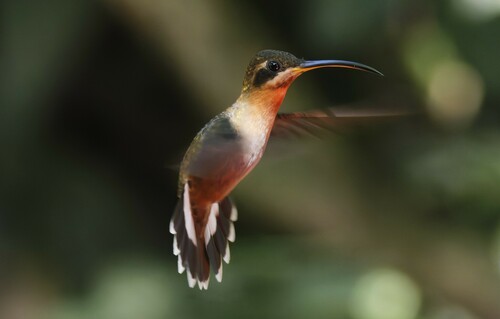
Band-tailed Barbthroat
Threnetes ruckeri
A master of the tropical understory, the Band-tailed Barbthroat is easily recognized by its 'bearded' throat and perfectly curved bill. This methodical 'trap-liner' brings a touch of shaded elegance to the dense forests of Central and South America.
Quick Identification
Size
10–11 cm (4–4.3 in) in length; weight approximately 5–7 g (0.18–0.25 oz)
Colors
Bronzy-green upperparts, dusky-grey underparts, blackish throat patch bordered by buff, and a tail featuring white tips with a broad black subterminal band.
Key Features
- Distinctive blackish 'beard' or throat patch
- Heavily decurved black bill with a pale base
- Tail feathers tipped in white with a bold black band
- Bronzy-green crown and back
When You’ll See Them
Geographic range
Where Does the Band-tailed Barbthroat Live?
The Band-tailed Barbthroat is native to the lush, tropical corridors of Central and South America. Its range begins in southeastern Guatemala and Belize, stretching southward through the Caribbean slopes of Honduras, Nicaragua, Costa Rica, and Panama. In South America, it is primarily found in the humid lowlands of western Colombia, western Ecuador, and into the northwestern reaches of Venezuela. This species is a dedicated resident of these regions, rarely wandering far from its preferred moist, shaded habitats.
Basemap © OpenStreetMap contributors
Behavior
The Band-tailed Barbthroat is a distinctively low-profile hummingbird, preferring the shaded safety of the forest understory rather than the bright canopy. Unlike many aggressive hummingbirds that fiercely guard a single patch of flowers, the barbthroat is a 'trap-liner.' This means it follows a consistent, daily route between widely dispersed nectar sources, moving methodically through the forest like a delivery driver on a set schedule.
In social settings, they are relatively quiet and solitary. They are most frequently observed near large, tubular flowers like Heliconias, where their curved bills are perfectly adapted for feeding. While they are not typically known for interacting with humans, they can become accustomed to observers if their habitat remains undisturbed and their favorite nectar plants are present.
EverydayEarth exclusive
Camera Tips
To capture the Band-tailed Barbthroat, you must think low. Unlike other hummingbirds that zip around at eye level, barbthroats are understory specialists. Position your AI-powered camera between 2 and 4 feet off the ground, focusing on large-leafed tropical plants like Heliconia, Ginger, or Bird of Paradise. These birds have very predictable 'trap-lining' routes, so if you see one visit a flower, there is a high probability it will return to that exact spot at a similar time the following day.
Because hummingbirds move at incredible speeds, set your camera to its highest possible frame rate or 'Burst Mode.' A fast shutter speed is essential to freeze the motion of their wings and reveal the white tips of the tail feathers. If your camera supports it, use a high-sensitivity PIR (Passive Infrared) sensor setting, as their small body mass can sometimes fail to trigger less sensitive motion detectors.
Lighting in the deep understory can be tricky. Position your camera so it faces away from the morning sun to avoid silhouetting the bird. If you are using a trail camera, look for 'Natural Light' settings that prioritize shutter speed over low ISO to ensure the bird isn't just a green blur. Avoid using heavy flash if possible, as the sudden light in a dark understory can startle these cautious birds and disrupt their feeding route.
Similar Species
Species that look similar or are commonly confused with Band-tailed Barbthroat.
Frequently Asked Questions
Record Band-tailed Barbthroat at your habitat
Connect a camera to start building your own species record — AI identifies every visitor automatically.