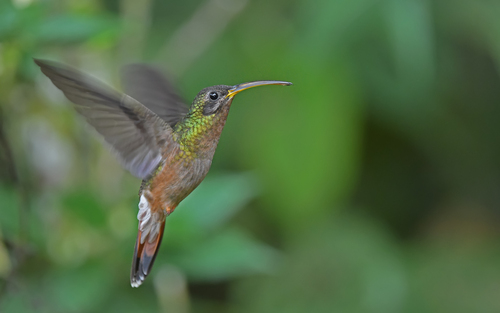
Rufous-breasted Hermit
Glaucis hirsutus
Master of the tropical understory, the Rufous-breasted Hermit is a unique hummingbird known for its curved bill and remarkable hanging nests.
Quick Identification
Size
Length: 10–12 cm (4–4.7 in); Weight: 5–8 g (0.18–0.28 oz)
Colors
Bronzy-green upperparts with rich rufous-cinnamon underparts; bill has a yellow lower mandible; tail is dark with prominent white tips.
Key Features
- Strongly decurved bill with yellow lower mandible
- Rich rufous-cinnamon breast and belly
- White-tipped tail feathers with a dark subterminal band
- Nests suspended from the underside of large leaves
When You’ll See Them
Geographic range
Where Does the Rufous-breasted Hermit Live?
This species is a widespread resident of the Neotropics, ranging from southern Panama across northern South America to Bolivia and central Brazil. It is particularly common in the Caribbean on the islands of Trinidad, Tobago, and Grenada. You will typically find them in lowland humid environments where their specialized food plants are most abundant.
Basemap © OpenStreetMap contributors
Behavior
The Rufous-breasted Hermit is a high-energy hummingbird known for its 'trap-lining' foraging strategy. Instead of defending a single territory, it follows a consistent daily route through the forest undergrowth, visiting specific flowering plants in a predictable circuit. This bird is quite inquisitive and may approach humans or cameras to investigate new objects in its environment, often hovering at eye level for several seconds before darting away.
Their nesting behavior is among the most fascinating in the bird world. They build elongated, cone-shaped nests made of plant fibers and spider silk, which they attach to the underside of a large leaf, such as a Heliconia or palm frond. This architectural choice protects the eggs and chicks from tropical downpours and arboreal predators. While typically solitary, they are often seen in the same vicinity as other hummingbirds near rich nectar sources.
EverydayEarth exclusive
Camera Tips
To successfully capture the Rufous-breasted Hermit on your backyard or trail camera, the most important factor is plant selection. These birds are Heliconia specialists. Place your camera 3 to 4 feet above the ground, angled directly toward a blooming Heliconia or ginger plant. Since these birds are 'trap-liners,' they follow a strict schedule; if you see one at 8:00 AM, there is a very high probability it will return to that same flower at the same time tomorrow.
Because hummingbirds move with lightning speed, your camera's shutter speed or trigger interval needs to be as fast as possible. If using an AI-powered camera, set it to 'burst mode' to capture the moment they hover to feed. To get the best color definition of their bronzy-green backs and rufous bellies, position the camera in a spot with bright, indirect light. Direct tropical sun can cause harsh shadows and blow out the highlights on their feathers.
If you don't have their favorite flowers, you can attract them with a nectar feeder, but look for one with longer ports that accommodate their curved bills. Mounting the camera 2-3 feet from the feeder is ideal for macro-style shots. Finally, look for their flight corridors—they often fly low through the undergrowth along the same paths. Setting a camera along these 'low-altitude highways' can result in stunning action shots of them in flight.
Similar Species
Species that look similar or are commonly confused with Rufous-breasted Hermit.
Frequently Asked Questions
Record Rufous-breasted Hermit at your habitat
Connect a camera to start building your own species record — AI identifies every visitor automatically.