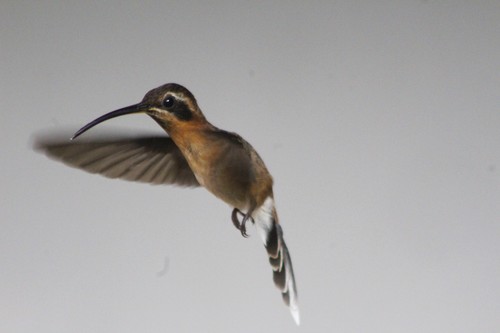
Little Hermit
Phaethornis longuemareus
A pint-sized dynamo of the tropical undergrowth, the Little Hermit is famous for its curved bill and its habit of following 'traplines' through the forest. This elusive nectar-feeder brings a touch of bronze-green magic to the shaded gardens of the Caribbean and South America.
Quick Identification
Size
Length: 8.4–9 cm (3.3–3.5 in); Weight: 2.5–3.5 g (0.09–0.12 oz)
Colors
Bronze-green upperparts, rich buff/ochre underparts, dark facial mask, and a long, decurved bill with a yellow base on the lower mandible.
Key Features
- Long, strongly decurved bill with yellow lower mandible
- Prominent dark 'mask' through the eye bordered by pale streaks
- Tapered tail with white tips on shorter outer feathers
- Uniformly ochre-colored belly and throat
When You’ll See Them
Geographic range
Where Does the Little Hermit Live?
Native to the northern tropical regions of South America, the Little Hermit is a lowland specialist. Its core range spans north-eastern Venezuela through the Guianas—including Guyana, Suriname, and French Guiana—and it is a common resident on the island of Trinidad. While it prefers the humid edges of forests and semi-open woodlands, it has adapted well to human-altered landscapes like plantations and suburban gardens near forest fringes.
Basemap © OpenStreetMap contributors
Behavior
The Little Hermit is a high-energy bird characterized by its 'traplining' foraging strategy. Unlike many other hummingbirds that fiercely defend a single patch of flowers, the Little Hermit follows a consistent daily route, visiting specific flowering plants in a precise sequence across a large territory. This makes them predictable visitors if you can identify their preferred path.
Socially, males are known for forming leks—communal display grounds—where up to several dozen birds gather in the dense undergrowth. They spend much of their time perched on low branches, singing persistent, high-pitched chirps to attract females. Despite their tiny size, they are remarkably bold and will often hover just inches away from a quiet observer to investigate.
EverydayEarth exclusive
Camera Tips
To capture the Little Hermit on camera, you must think low. Unlike many hummingbirds that zip through the canopy, hermits are understory specialists. Position your camera about 2 to 4 feet off the ground, aiming at tubular red or orange flowers like Heliconia or shrimp plants. Because they follow a 'trapline' route, if you see one once, it is highly likely to return to that exact spot at roughly the same time every day.
Standard trail cameras can struggle with the speed of a Little Hermit. Use a camera with a fast trigger speed (0.2s or less) or, ideally, an AI-powered bird camera with a 'Burst Mode' to capture multiple frames per second. High-speed shutter settings are essential to freeze their rapid wingbeats, though some motion blur can add a beautiful sense of action to the shot.
Since these birds prefer the shaded undergrowth, lighting can be a challenge. Place your camera in a spot that receives 'dappled' sunlight rather than deep shade to ensure enough light hits the sensor without blowing out the highlights. If using a backyard feeder, choose a nectar feeder with long ports that mimic the tubular flowers they naturally prefer, and place it near dense shrubbery where they feel secure.
Similar Species
Species that look similar or are commonly confused with Little Hermit.
Long-billed Hermit
Much larger size and a significantly longer, more curved bill; lacks the rich ochre underparts.
Rufous-breasted Hermit
Has a more uniform rufous chest and a bill that is less curved than the Little Hermit's.
Green Hermit
Found at higher elevations and is much larger with darker, more saturated green plumage.
Frequently Asked Questions
Record Little Hermit at your habitat
Connect a camera to start building your own species record — AI identifies every visitor automatically.