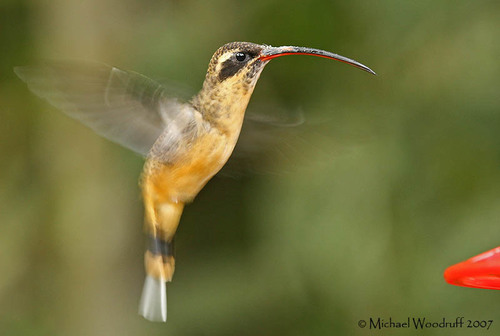
Tawny-bellied Hermit
Phaethornis syrmatophorus
A master of the Andean understory, the Tawny-bellied Hermit is easily recognized by its long, curved bill and striking ochre plumage. This trap-lining traveler brings a splash of warm color to the misty cloud forests of South America.
Quick Identification
Size
13.5-15 cm (5.3-5.9 in) in length; weighs approximately 5-7 g (0.18-0.25 oz)
Colors
Bronzy-green upperparts, rich tawny or ochre underparts, dark facial mask with buffy streaks, and a dark bill with a reddish lower mandible base.
Key Features
- Long, strongly decurved bill
- Distinctive rich tawny-buff belly and breast
- Extremely long, white-tipped central tail feathers
- Dark 'mask' across the eyes with pale eyebrow and malar stripes
When You’ll See Them
Geographic range
Where Does the Tawny-bellied Hermit Live?
The Tawny-bellied Hermit is a quintessential resident of the South American Andes, making its home in the lush, mist-shrouded cloud forests of the continent's northwestern region. Its native range stretches through the humid montane forests of Colombia and Ecuador, extending south into the northern reaches of Peru. This species is primarily found on both the eastern and western slopes of the Andes, favoring the dense, damp undergrowth where its favorite nectar-producing plants thrive in the shadows.
Basemap © OpenStreetMap contributors
Behavior
The Tawny-bellied Hermit is a specialized 'trap-lining' feeder, meaning it doesn't defend a single territory of flowers like many other hummingbirds. Instead, it follows a consistent, long-distance route through the forest understory, visiting specific nectar-rich plants at regular intervals. This high-energy lifestyle requires them to be constantly on the move, though they are often quite approachable if they become accustomed to a specific garden or feeder along their route.
Socially, these birds are mostly solitary except during the breeding season when males gather in 'leks.' At these leks, several males will sing persistent, squeaky songs from low perches to attract females. They are understory specialists, rarely venturing into the bright canopy, preferring the shaded, humid interior of primary and secondary forests where they can move through the shadows undetected by predators.
EverydayEarth exclusive
Camera Tips
To capture the elusive Tawny-bellied Hermit, positioning your AI-powered camera in the shaded understory is crucial, as these birds avoid the bright, open canopy. Unlike many hummingbirds that defend a single feeder, hermits are trap-liners. Look for large, tubular flowers like Heliconia; if you see a hermit visiting one, it is highly likely to return to that exact spot at roughly the same time every day. Set your camera on a tripod at a height of 3 to 5 feet, angled slightly upward to capture the distinctive curve of its long bill and the rich colors of its belly.
Because these birds move with incredible speed, use a camera with a fast trigger time (under 0.2 seconds) and high-speed burst mode if available. If your camera allows for manual focus, pre-focus on a specific flower bloom where the bird is likely to hover. In the dim light of the cloud forest understory, a camera with good low-light sensitivity is beneficial to bring out the bronzy-green tones of its back without washing out the tawny underparts with a harsh flash.
While standard hummingbird feeders can work, the Tawny-bellied Hermit is more attracted to natural setups. Try planting native, nectar-rich tubular plants in a tiered garden that mimics a forest edge. If using a feeder, choose one with a perch, as hermits occasionally prefer to sit while feeding, which provides much clearer photos. The best time for activity is during the early morning (6:00 AM to 9:00 AM) when nectar production is at its peak and the forest is coming alive.
Similar Species
Species that look similar or are commonly confused with Tawny-bellied Hermit.
Frequently Asked Questions
Record Tawny-bellied Hermit at your habitat
Connect a camera to start building your own species record — AI identifies every visitor automatically.