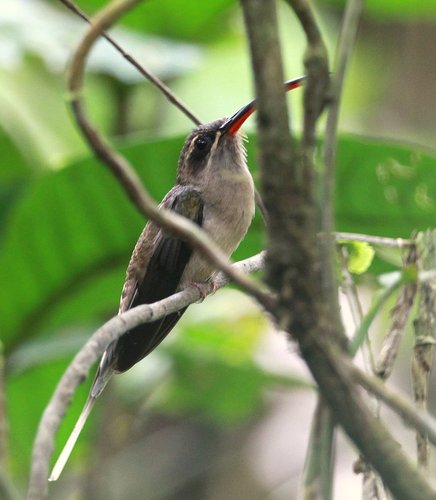
Great-billed Hermit
Phaethornis malaris
The Great-billed Hermit is the elegant 'trap-liner' of the Amazon, recognizable by its incredible curved beak and spiked tail. A shadow-dwelling specialist, this hummingbird turns the deep forest understory into its own private nectar route.
Quick Identification
Size
Length: 13-17 cm (5.1-6.7 in); Weight: 4-10 g (0.14-0.35 oz)
Colors
Bronzy-green upperparts; buff or ochraceous underparts; dark facial mask with buffy streaks; long white-tipped central tail feathers
Key Features
- Extremely long and heavily decurved bill with yellow base
- Distinctive long, white-tipped central tail feathers forming a spike
- Dark ear-patch or mask bordered by pale facial stripes
- Large size compared to most hummingbirds
When You’ll See Them
Geographic range
Where Does the Great-billed Hermit Live?
The Great-billed Hermit is a quintessential species of the South American Neotropics. Its vast range is centered in the Amazon Basin, stretching across northern and central Brazil, eastern Peru, and southern Colombia. It is also frequently spotted in the humid lowlands of Ecuador, Bolivia, Venezuela, and the Guyanas, where it thrives in the dense, shaded understory of primary and secondary tropical forests.
Basemap © OpenStreetMap contributors
Behavior
The Great-billed Hermit is a master of the forest understory, known primarily for its 'trap-lining' foraging strategy. Instead of defending a single patch of flowers like many aggressive hummingbirds, this species follows a fixed daily route that can cover several kilometers, visiting specific flowering plants in a predictable sequence. This makes them remarkably consistent visitors if your camera is placed along one of their established paths.
During the breeding season, males are known for their vocal leks. They gather in specific areas of the forest, perching on low branches to sing persistent, high-pitched songs while wagging their long, white-tipped tails. They are generally solitary and less social than other bird species, spending much of their time moving quickly through the shaded layers of the rainforest where they are protected from predators.
EverydayEarth exclusive
Camera Tips
To successfully capture the Great-billed Hermit on an AI-powered camera, you must focus on the understory layer of the forest rather than open clearings. These birds rarely venture into bright, open spaces, preferring the safety of the shade. Look for large-leafed plants with red or orange tubular flowers, such as Heliconia or wild ginger. Position your camera about 1 to 1.5 meters (3-5 feet) off the ground, aiming directly at a cluster of blooms. A side-view angle is essential to capture the bird's most defining feature: its massive, curved bill.
Because Great-billed Hermits are 'trap-liners,' they are creatures of habit. If you see one visit a flower at 8:00 AM, there is a very high probability it will return to that exact spot at roughly the same time the following day. Use this to your advantage by ensuring your camera is active and has fresh batteries during their peak morning rounds. If you are using an AI camera with adjustable trigger speeds, set it to the fastest possible setting; while Hermits hover more slowly and deliberately than smaller hummingbirds, their approach and departure are still lightning-fast.
Lighting in the deep rainforest can be tricky for most sensors. Try to find a spot where a 'light gap'—a hole in the canopy—allows a shaft of natural light to hit the flowers for part of the day. Avoid using a harsh flash if possible, as it can wash out the subtle bronzy-green of their plumage and potentially startle the bird. If your camera allows for video, a 10-second clip is often better than a still photo, as it captures the characteristic tail-wagging behavior that occurs while the bird is hovering and feeding.
Similar Species
Species that look similar or are commonly confused with Great-billed Hermit.
Frequently Asked Questions
Record Great-billed Hermit at your habitat
Connect a camera to start building your own species record — AI identifies every visitor automatically.