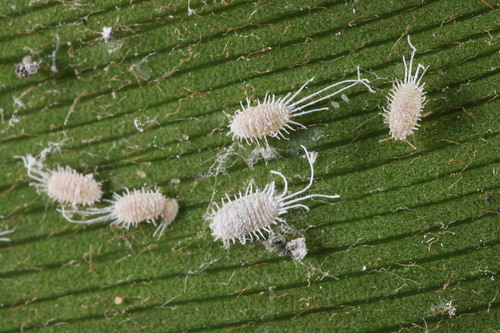
long-tailed mealybug
Pseudococcus longispinus
The long-tailed mealybug is a master of waxy armor, recognizable by the elegant, thread-like filaments that trail behind its body. This tiny sap-sucker creates its own miniature ecosystem, often protected by 'ant farmers' who prize the sugary nectar the mealybug provides.
Quick Identification
Size
3–4 mm (0.12–0.16 inches) long, with tail filaments often exceeding the length of the body.
Colors
White powdery wax coating over a pale yellow or pinkish-grey body; distinctive white lateral filaments.
Key Features
- Two exceptionally long anal filaments trailing behind the body
- Covered in a white, cottony waxy secretion
- 17 pairs of waxy filaments along the body margins
- Oval-shaped, segmented body with no visible wings in females.
When You’ll See Them
Behavior
Long-tailed mealybugs are slow-moving insects that spend the majority of their lives clinging to host plants. Unlike many other mealybug species that lay eggs in cottony sacs, the long-tailed mealybug is ovoviviparous, meaning the females give birth to live, mobile nymphs known as 'crawlers.' This allows them to quickly colonize a plant once a single female finds a suitable feeding spot.
These insects are frequently found in symbiotic relationships with ants. The mealybugs excrete a sugary waste product called honeydew, which ants harvest for food. In exchange, the ants act as tiny bodyguards, aggressively defending the mealybugs from ladybugs, lacewings, and parasitic wasps. If you see ants marching up and down a plant stem, there is a high probability they are tending to a colony of long-tailed mealybugs.
EverydayEarth exclusive
Camera Tips
Capturing the long-tailed mealybug requires a specialized approach due to their diminutive size. Standard backyard trail cameras will likely miss them unless they have a dedicated macro lens or a very short minimum focus distance. Position your camera approximately 3 to 6 inches away from the host plant's 'hotspots'—specifically the undersides of leaves, the junctions where leaves meet the stem (axils), and around new growth or developing fruit.
Because these insects are white and waxy, they reflect light easily, which can cause 'blowout' in your photos where the detail is lost in a white blur. To combat this, aim for diffused, natural light. If your camera setup uses an external flash or LED, place a small piece of translucent tape or white fabric over the light source to soften the glare. This will help reveal the intricate texture of their waxy filaments and the distinct 'long tails' that give them their name.
Look for 'biological indicators' to decide where to mount your camera. A buildup of sticky honeydew on lower leaves or a steady stream of ant traffic are neon signs that a mealybug colony is nearby. Set your camera to a time-lapse mode or high-resolution trigger with a fast shutter speed to capture the subtle movements of the crawlers, which move much faster than the sedentary adults.
Seasonally, the best time to capture high-density colonies is during periods of high humidity and warm temperatures. In many gardens, this coincides with the lush growth of late spring. If you are using an AI-powered camera, ensure it is trained to recognize white, cottony clusters, as the camera might otherwise mistake the colony for a spot of fungus or bird droppings.
Similar Species
Species that look similar or are commonly confused with long-tailed mealybug.
Frequently Asked Questions
Record long-tailed mealybug at your habitat
Connect a camera to start building your own species record — AI identifies every visitor automatically.