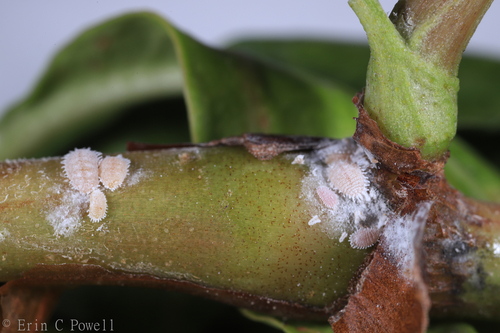
Citrus Mealybug
Planococcus citri
The citrus mealybug may look like a tiny tuft of cotton, but this waxy wonder is a master of survival. Found in gardens and greenhouses worldwide, these sap-sucking insects build miniature empires protected by loyal ant bodyguards.
Quick Identification
Size
3-4 mm (0.12-0.16 inches) in length; males are much smaller and winged but rarely seen.
Colors
White waxy coating over a pinkish or yellowish body; distinct dark longitudinal stripe visible through the wax on some individuals.
Key Features
- Oval-shaped body covered in white, mealy wax
- Short, fringe-like waxy filaments around the body perimeter
- Small, inconspicuous legs visible only from the underside
- Secretes sticky honeydew that often hosts black sooty mold
When You’ll See Them
Geographic range
Where Does the Citrus Mealybug Live?
The citrus mealybug is believed to be native to tropical and subtropical regions of Southern Asia, but it has successfully traveled across the globe via the international plant trade. Today, it maintains a massive footprint across every continent except Antarctica. In the United States, it is a common sight in the warm climates of Florida, California, and Texas, while in cooler regions, it thrives year-round within the protected environments of commercial greenhouses and residential homes.
Basemap © OpenStreetMap contributors
Behavior
Citrus mealybugs are primarily sedentary insects that live in dense colonies. They spend the majority of their lives tucked into the crevices of plants, such as leaf axils, fruit clusters, or under bark, where they use their piercing-sucking mouthparts to drink nutrient-rich sap. While females are wingless and move slowly if disturbed, the short-lived males possess wings but lack mouthparts, existing only to find mates.
These insects are famous for their symbiotic relationship with ants. The mealybugs excrete a sugary waste product called honeydew, which ants harvest as a primary food source. In exchange, ants act as personal bodyguards, aggressively defending the mealybugs from ladybugs and parasitic wasps. This interaction often leads to larger mealybug populations in gardens where ants are prevalent.
EverydayEarth exclusive
Camera Tips
Capturing the citrus mealybug requires a specialized approach due to their tiny size and habit of hiding in shadows. Use a dedicated macro lens or a high-quality close-up attachment for your backyard camera. To get a clear shot, focus your lens on the 'nodes' of a plant—the points where leaves meet the stem—or the undersides of new growth, as these are their favorite congregating spots.
Lighting is your biggest challenge. Because these insects are bright white and waxy, they easily 'blow out' or lose detail in direct sunlight. Set your camera for early morning or late afternoon light, or use a diffuser to soften harsh midday sun. If your camera allows for manual exposure, slightly underexpose the shot to preserve the intricate texture of their waxy filaments.
A great trick for finding them is to follow the ants. If you see ants marching up and down a specific branch, they are likely tending a mealybug colony nearby. Position your camera at the junction of a leaf and stem and use a time-lapse setting. While individual mealybugs don't move much, a time-lapse over several hours will reveal their slow shifts and the fascinating 'farming' behavior of the ants that visit them.
Similar Species
Species that look similar or are commonly confused with Citrus Mealybug.
Long-tailed Mealybug
Features much longer waxy tail filaments that can be as long as or longer than its entire body.
Comstock Mealybug
Nearly identical in appearance but has two distinct long waxy tails that are shorter than the Long-tailed variety but longer than the Citrus species.
Cottony Cushion Scale
Much larger (up to 10mm) with a distinctly fluted, elongated white egg sac that looks like a miniature accordion.
Frequently Asked Questions
Record Citrus Mealybug at your habitat
Connect a camera to start building your own species record — AI identifies every visitor automatically.