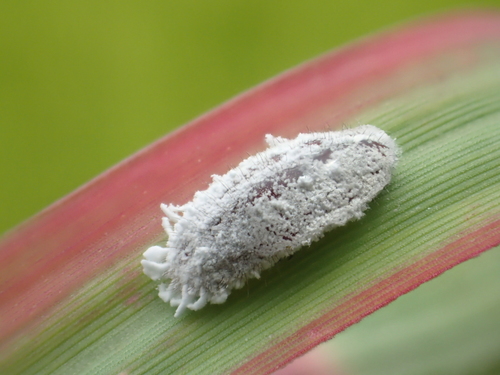
Comstock Mealybug
Pseudococcus comstocki
A tiny, waxy hitchhiker from East Asia, the Comstock Mealybug has become a master of disguise in backyard orchards worldwide. Known for its distinctive 'tailed' appearance and love for fruit trees, this microscopic marvel is a fascinating study in insect adaptation.
Quick Identification
Size
Adult females range from 3 to 5 mm (0.12 to 0.20 inches) in length; males are much smaller and winged.
Colors
Powdery white waxy coating over a reddish-brown or grayish-pink body; filaments are white.
Key Features
- Oval body covered in white, mealy wax
- Short waxy filaments around the margin
- Two long posterior filaments (tails) about 1/3 the body length
- Produces clear, sticky honeydew
- Commonly found in bark crevices and fruit clusters
When You’ll See Them
Geographic range
Where Does the Comstock Mealybug Live?
The Comstock Mealybug is originally native to East Asia, with its roots traced back to Japan and China where it was first identified at the turn of the 20th century. Since its discovery, it has become a cosmopolitan invasive species, establishing robust populations throughout much of North America, particularly in the fruit-growing regions of the United States and southern Canada. It has also spread extensively across Europe and parts of South America, thriving wherever temperate or subtropical fruit crops are cultivated.
Basemap © OpenStreetMap contributors
Behavior
The Comstock Mealybug is a sedentary sap-sucker known for its slow-moving nature and communal lifestyle. Once they find a suitable feeding spot, usually in the crevices of bark or near the stems of fruit, they settle down to pierce the plant tissue with their needle-like mouthparts. They are social in the sense that they often aggregate in large, cottony clusters to provide collective protection against desiccation and predators.
As they feed, these insects excrete a sticky, sugar-rich substance known as honeydew. This behavior often attracts ants, which form a symbiotic relationship with the mealybugs, protecting them from ladybugs and lacewings in exchange for the sugary treat. For homeowners, the most visible sign of their presence is often the growth of black sooty mold on the honeydew-covered leaves, rather than the insects themselves.
EverydayEarth exclusive
Camera Tips
Capturing the Comstock Mealybug on camera requires a dedicated macro setup, as these tiny insects are easily missed by standard wide-angle backyard lenses. For the best results, use a camera with a high-resolution macro mode or a clip-on macro lens for your mobile device. Focus your efforts on the 'hotspots' of the tree: the crotches of branches, underneath loose bark, or near the base of developing fruit. These insects prefer sheltered areas where they are protected from direct wind and rain.
Because mealybugs are largely stationary, they are the perfect subjects for time-lapse photography. Set your camera to take a photo every 15 to 30 minutes over a period of several days to witness the colony's growth and the movement of attendant ants. If your camera allows for external lighting, use a ring light or side-mounted LED to create shadows that define the texture of their white waxy filaments, which can otherwise look like a flat white blob in bright, direct sun.
Placement is key; position your camera 2–6 inches away from the infested area. Since you are likely looking for them in garden or orchard settings, ensure your camera is securely mounted to a tripod or a flexible arm attached to a branch. Check the lens frequently, as the honeydew secreted by the mealybugs is sticky and can quickly fog up or residue-coat your equipment if placed too close to the feeding site.
Similar Species
Species that look similar or are commonly confused with Comstock Mealybug.
Long-tailed Mealybug
Features much longer posterior filaments that often exceed the length of the body, whereas Comstock's are only about 1/3 the body length.
Citrus Mealybug
Lacks the long posterior filaments of the Comstock Mealybug and has a faint dark stripe running down its back.
Cottony Cushion Scale
Much larger with a distinctively ridged, elongated egg sac that is much tougher and more structured than the loose wax of a mealybug.
Frequently Asked Questions
Record Comstock Mealybug at your habitat
Connect a camera to start building your own species record — AI identifies every visitor automatically.