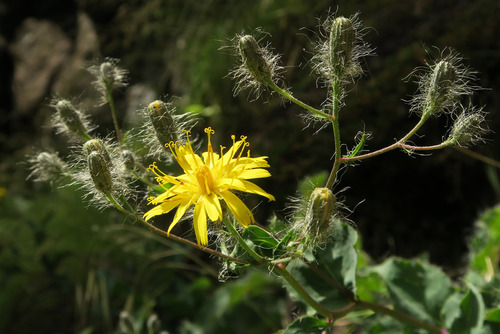
longbeard hawkweed
Hieracium longiberbe
Meet the cliff-dwelling rarity of the Pacific Northwest. With its shaggy, 'bearded' leaves and bright yellow blooms, the longbeard hawkweed is a botanical treasure found only in one place on Earth.
Quick Identification
Size
Stems reach 15-40 cm (6-16 inches) in height; flower heads are approximately 1-2 cm (0.4-0.8 inches) wide.
Colors
Bright yellow flower heads; pale green to sage-green leaves covered in distinctive long, shaggy white hairs.
Key Features
- Long, shaggy white hairs (up to 1cm) on leaves and stems
- Yellow dandelion-like flower heads in loose clusters
- Basal leaves are narrow and lance-shaped
- Found exclusively on basalt rock faces and rocky slopes
When You’ll See Them
Geographic range
Where Does the longbeard hawkweed Live?
Native to the North American continent, longbeard hawkweed is one of the rarest plants in the Pacific Northwest. It is found exclusively within the Columbia River Gorge, a narrow geographic corridor that forms the border between the states of Oregon and Washington in the United States. Its entire global population is confined to the rocky, moisture-misted basalt walls that line this iconic river canyon.
Basemap © OpenStreetMap contributors
Behavior
Longbeard hawkweed is a perennial wildflower that has adapted to the rugged, vertical environment of basalt cliffs. Unlike many other hawkweeds that spread aggressively, this species is a site-specific specialist, slowly growing in the cracks and crevices of ancient rock. It spends much of the year as a low-lying rosette of shaggy green leaves, which help trap moisture and protect the plant from the drying winds of the Columbia River Gorge.
During its blooming period in early to mid-summer, the plant sends up a slender, hairy stalk topped with several yellow flower heads. These flowers follow a diurnal rhythm, opening fully in the morning to attract specialist pollinators like native bees and hoverflies, and often closing or drooping slightly during the peak heat of the afternoon or in heavy rain. Because it is a rare endemic, it plays a small but vital role in its specific rock-face ecosystem, providing a food source for insects in areas where few other plants can survive.
EverydayEarth exclusive
Camera Tips
Capturing the longbeard hawkweed on a backyard or trail camera requires a shift from motion-triggering to time-lapse settings. Since this plant is a 'cliff-hanger,' you likely won't find it in a standard suburban lawn; however, if you live near the rocky outcrops of the Columbia River Gorge, you can position your camera to document its rare blooming cycle. Set your camera to take a photo every 30 to 60 minutes during the daylight hours from June through August to capture the dramatic unfurling of its yellow florets.
To highlight the plant’s namesake 'long beard,' placement is everything. Position your camera at a side-profile angle relative to the leaves. This allows the backlight of the morning sun to catch the long, white hairs, making them glow against the darker basalt rock behind them. If your camera has a macro or close-focus setting, use it—the fine details of the shaggy hairs are the key identifying feature and make for a much more compelling image than a wide-angle shot.
Because longbeard hawkweed attracts a variety of pollinators, you can also use your camera to document 'wildlife interactions.' Set your AI camera to its highest sensitivity or use a short-interval time-lapse to catch native bees and butterflies visiting the yellow flowers. Since these plants often grow on steep slopes, ensure your camera mount is extremely secure; the high winds of the Gorge can easily vibrate a loose camera, resulting in blurry images of these delicate flowers.
Similar Species
Species that look similar or are commonly confused with longbeard hawkweed.
Frequently Asked Questions
Record longbeard hawkweed at your habitat
Connect a camera to start building your own species record — AI identifies every visitor automatically.