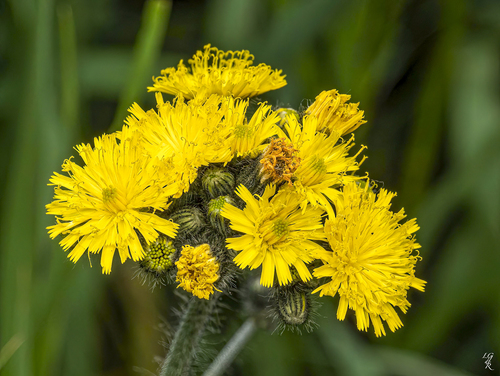
meadow hawkweed
Pilosella caespitosa
A hardy perennial with a 'king devil' reputation, meadow hawkweed stands out with its clusters of brilliant yellow blooms and distinctive bristly stems. While a fierce competitor in the meadow, it provides a vital summer nectar hub for backyard pollinators.
Quick Identification
Size
Stems reach 25–90 cm (10–35 inches) in height; flower heads are 1.5–2 cm (0.6–0.8 inches) wide
Colors
Bright yellow flower heads with dark, glandular black hairs on the stems and bracts; deep green foliage
Key Features
- Basal rosette of hairy, lance-shaped leaves
- Multiple yellow flower heads in a tight cluster atop a single stalk
- Stems contain a milky white sap
- Distinctive black-based, bristly hairs covering the stem and leaves
When You’ll See Them
Geographic range
Where Does the meadow hawkweed Live?
Originally native to the temperate regions of Northern, Central, and Eastern Europe as well as Northern Asia, meadow hawkweed has become a widespread naturalized species across much of the globe. It is most prominently established in North America, where it blankets vast areas of the Pacific Northwest, the Great Lakes region, and the Northeastern United States and Southern Canada. It thrives in cooler temperate climates and is frequently found colonizing disturbed forest edges and high-elevation meadows where native grasses have been thinned.
Basemap © OpenStreetMap contributors
Behavior
Meadow hawkweed is a perennial herbaceous plant known for its highly aggressive and colonial growth habit. Unlike many wildflowers that grow in isolation, this species uses a "triple-threat" reproductive strategy to dominate its environment. It spreads via wind-dispersed seeds, underground rhizomes, and creeping above-ground stolons—similar to strawberry runners—which allow it to form dense, mat-like monocultures that choke out native vegetation.
The plant spends most of its early life as a low-lying basal rosette, hugging the ground to capture light while preventing other seeds from germinating beneath it. During the late spring and summer, it sends up its characteristic flowering stalks. While it is considered a noxious weed in many regions due to its impact on biodiversity and agricultural land, it is a significant nectar source for small bees, hoverflies, and butterflies during its peak blooming period.
EverydayEarth exclusive
Camera Tips
Capturing meadow hawkweed with an AI-powered backyard camera offers a unique opportunity to document the micro-ecosystem of pollinators it supports. For the best results, mount your camera on a low-profile stake or a ground-level tripod, positioning the lens approximately 12 to 15 inches away from a healthy cluster of flower heads. Ensure the camera is angled slightly upward to capture the contrast of the bright yellow petals against the sky, which helps AI models distinguish the plant from the surrounding green foliage.
Because these flowers are highly sensitive to light, timing is everything. Meadow hawkweed heads typically open in the mid-morning and may close by late afternoon or during heavy overcast weather. Set your camera to a time-lapse mode or a high-frequency trigger during the hours of 10 AM to 2 PM. This is when the yellow blooms are most vibrant and when you are most likely to capture visiting insects like the small copper butterfly or various solitary bees that frequent the nectar-rich florets.
Pay close attention to the "hairy" details that define this species. To help the AI identify Pilosella caespitosa specifically, ensure the camera's focus is sharp on the upper third of the stem. The dense, black glandular hairs are a primary diagnostic feature. If your camera allows for macro settings, use them to get clear shots of these bristles. This level of detail not only makes for a stunning photograph but also assists in citizen science efforts to map the spread of this invasive species versus native lookalikes.
Similar Species
Species that look similar or are commonly confused with meadow hawkweed.
Frequently Asked Questions
Record meadow hawkweed at your habitat
Connect a camera to start building your own species record — AI identifies every visitor automatically.