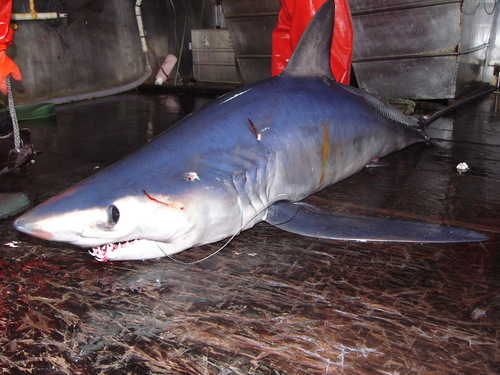
Longfin Mako
Isurus paucus
Meet the Longfin Mako, the elusive, deep-sea cousin of the world's fastest shark. With its striking long fins and large, soulful eyes, this 'ocean wanderer' is a masterpiece of pelagic evolution.
Quick Identification
Size
Typically 2.5 to 4.3 meters (8.2 to 14 feet) in length; adults can weigh up to 70 kg (154 lbs), though they are slimmer than their shortfin cousins.
Colors
Deep metallic blue to bluish-black on the dorsal side, fading to a stark white on the belly; distinctive dusky pigmentation on the underside of the snout.
Key Features
- Extremely long pectoral fins, equal to or longer than the head
- Large, circular eyes without a protective nictitating membrane
- Slender, streamlined body with a sharply pointed snout
- Dusky or dark coloration on the underside of the snout and around the mouth
When You’ll See Them
Geographic range
Where Does the Longfin Mako Live?
The Longfin Mako maintains a vast, global presence across the tropical and warm temperate waters of the Atlantic, Pacific, and Indian Oceans. It is most frequently recorded in the Gulf Stream off the East Coast of the United States, around the coasts of Cuba and southern Brazil, and in the central Pacific near Hawaii. Because it is a deep-water traveler, its distribution is largely dictated by warm current patterns rather than coastal boundaries, making it a true citizen of the high seas.
Basemap © OpenStreetMap contributors
Behavior
The Longfin Mako is a mysterious pelagic wanderer, significantly less active than its famous relative, the Shortfin Mako. While it shares the family trait of being endothermic (warm-blooded), its physical build—particularly its broad, elongated pectoral fins—suggests a life spent cruising at slower, more energy-efficient speeds. This species is rarely encountered by humans, as it prefers the solitude of the open ocean and moderately deep waters.
Despite its slower reputation, it is a formidable predator that uses its massive eyes to hunt in the low-light conditions of the mesopelagic zone. Socially, little is known about their interactions, but they are believed to be solitary hunters. Unlike many sharks that flee from boats, Makos are known for their curiosity, though the Longfin is generally more elusive and less likely to engage in the high-speed breaching behavior seen in the Shortfin Mako.
EverydayEarth exclusive
Camera Tips
Capturing a Longfin Mako on camera is a specialized challenge that requires moving beyond the backyard and into the blue water. To document this species, researchers and offshore enthusiasts use Baited Remote Underwater Video (BRUV) systems. These rigs should be weighted to hang at depths between 50 and 150 meters, where the Longfin Mako is most likely to be cruising. Using a high-strength seafaring tether is essential to prevent losing your gear to the deep.
Scent is the primary lure for this species. A perforated bait canister filled with oily fish like chopped mackerel, sardines, or squid will create a 'chum slick' that draws the shark toward your camera lens. Because these sharks are naturally curious but can be cautious, it is best to use a wide-angle lens (170 degrees or more) to capture their full profile as they circle the bait. High-intensity underwater LEDs are recommended, as colors like red and orange are lost at depth, and the extra light will help highlight the shark's metallic blue skin.
For the best results, set your camera to a high frame rate (at least 60fps) to capture the fluid, serpentine movement of their long pectoral fins. If you are using a camera in a waterproof housing, ensure the seals are rated for at least 30 atmospheres of pressure. Deploy your gear near thermal fronts or continental shelf drops during the summer months, when pelagic activity is at its peak. Look for areas where vertical temperature gradients are sharp, as Makos often use these 'oceanic highways' to find prey.
Similar Species
Species that look similar or are commonly confused with Longfin Mako.
Frequently Asked Questions
Record Longfin Mako at your habitat
Connect a camera to start building your own species record — AI identifies every visitor automatically.