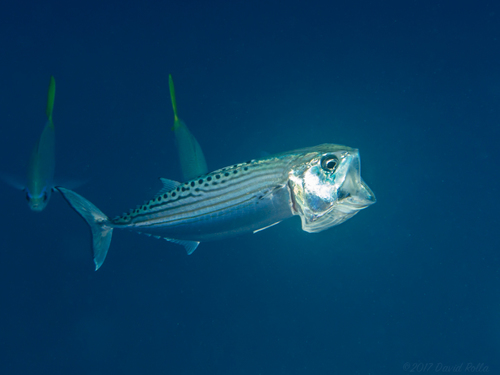
Longjaw Mackerel
Rastrelliger kanagurta
A flash of silver in the tropical surf, the Longjaw Mackerel is a fast-moving marvel of the Indo-Pacific. Known for its wide-mouthed feeding style and brilliant iridescent stripes, it is a favorite for underwater observers.
Quick Identification
Size
Typically ranges from 20 to 25 cm (8 to 10 inches), with a maximum length of 35 cm (14 inches). They usually weigh between 0.4 and 0.8 kg (0.9 to 1.8 lbs).
Colors
Back is iridescent blue-green with dark longitudinal bands; flanks and belly are shimmering silver-yellow; dorsal fins are yellowish with black tips.
Key Features
- Extraordinarily large mouth that extends past the rear of the eye when closed
- Deep-bodied, torpedo-shaped profile
- Dark spots or wavy lines along the upper half of the body
- Finlets located behind the second dorsal and anal fins
When You’ll See Them
Geographic range
Where Does the Longjaw Mackerel Live?
The Longjaw Mackerel is native to the vast Indo-West Pacific region, flourishing in warm tropical waters from the Red Sea and East Africa across to the central Pacific islands. Its core range includes the coastal seas of India, Thailand, Indonesia, the Philippines, and Vietnam, where it is one of the most abundant marine species. While it has not been widely introduced outside its native range, it has successfully migrated through the Suez Canal into the Mediterranean Sea, establishing a presence along the Levantine coast.
Basemap © OpenStreetMap contributors
Behavior
The Longjaw Mackerel is a highly energetic, pelagic fish known for its incredible speed and schooling behavior. They are social creatures that move in massive, tightly packed groups, which serves as a primary defense against larger predators like tuna, billfish, and sharks. When feeding, these schools move in a synchronized fashion, often near the surface of the water where sunlight catches their iridescent scales, creating a flashing silver effect.
These fish are unique among many mackerel species for their "ram feeding" technique. They swim with their mouths wide open, allowing water to flow over their specialized gill rakers to filter out microscopic nutrients. While they are a vital part of the marine food web, they are also a cornerstone species for coastal communities across the Indo-Pacific, featuring prominently in local markets and traditional cuisine.
EverydayEarth exclusive
Camera Tips
Capturing the Longjaw Mackerel on camera requires an underwater setup, ideally an action camera or a specialized underwater hub mounted to a pier, dock piling, or a weighted seafloor tripod. Because these fish are extremely fast, you should set your camera to a high frame rate—at least 60 or 120 frames per second—to avoid motion blur and capture the intricate details of their shimmering scales and wide-mouthed feeding behavior.
To attract a school to your "backyard" coastal camera, use a mesh chum bag filled with minced oily fish, shrimp, or squid. Position the camera roughly 1.5 to 2 meters (5 to 6 feet) away from the bait to ensure the lens can capture the entire school as they swirl around the food. In shallow water, angle the camera slightly downward to reduce glare from the surface and to take advantage of the natural light reflecting off the sandy bottom.
Timing is everything with this species. They are most active during the rising tide when nutrient-rich water is pushed toward the shore, bringing the mackerel in with it. Use the brightest part of the day, between 10 AM and 2 PM, for the best color saturation; the iridescence of their blue-green backs is most visible when the sun is directly overhead. If your camera supports AI triggering, set the sensitivity to high, as the rapid movement of a schooling mass can sometimes be missed by slower sensors.
Similar Species
Species that look similar or are commonly confused with Longjaw Mackerel.
Frequently Asked Questions
Record Longjaw Mackerel at your habitat
Connect a camera to start building your own species record — AI identifies every visitor automatically.