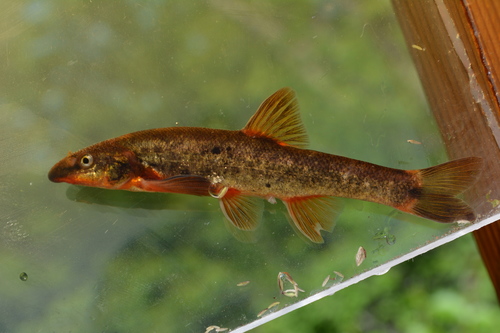
Longnose Dace
Rhinichthys cataractae
Master of the rapids, the Longnose Dace is a marvel of aquatic engineering. With its unique 'nose' and streamlined body, it thrives in the turbulent waters where few other species dare to swim.
Quick Identification
Size
Typically 6 to 10 cm (2.5 to 4 inches) in length; maximum recorded length around 17 cm (6.7 inches).
Colors
Olive to dark brown back with a lighter, creamy white underside. A faint dark lateral stripe often runs along the body, and breeding males may develop reddish coloration at the base of their fins and on their snouts.
Key Features
- Distinctive fleshy snout that overhangs the mouth
- Streamlined, cigar-shaped body adapted for fast currents
- Very small scales giving a smooth appearance
- Small eyes positioned high on the head
When You’ll See Them
Geographic range
Where Does the Longnose Dace Live?
The Longnose Dace boasts one of the widest distributions of any North American minnow, spanning the vast majority of the continent. Originally native to the clear, cool waters of the northern United States and Canada, its reach extends from the Atlantic coast all the way to the Pacific, and as far south as the Rio Grande drainage in northern Mexico. You are most likely to encounter these hardy fish in the Appalachian foothills, the Great Lakes basin, and throughout the Rocky Mountain streams where fast-moving water provides their ideal oxygen-rich environment.
Basemap © OpenStreetMap contributors
Behavior
The Longnose Dace is a specialist of high-energy environments, spending its life tucked between stones in the swiftest parts of streams and rivers. Unlike many other minnows that school in open water, the dace is a benthic (bottom-dwelling) species. Its lack of a functional swim bladder allows it to stay on the bottom easily, using its streamlined shape to minimize resistance against the rushing water.
These fish are generally solitary but can be found in high densities where the habitat is favorable. They are most active during the night, especially in the summer months, when they emerge from the crevices of the rocky substrate to forage. While they are relatively small, they are surprisingly bold and will tenaciously hold their ground in a current that would sweep larger fish away.
EverydayEarth exclusive
Camera Tips
To capture the Longnose Dace on camera, you will need a waterproof action camera or a specialized underwater housing for your AI camera. The best placement is in the 'riffle' section of a stream—the area where water ripples over rocks. Secure your camera to a heavy, flat rock or a weighted base to ensure the current doesn't sweep it away. Position the lens as low as possible, aiming horizontally across the surface of the gravel or upstream into the current.
Because dace are most active at night, look for cameras with high-quality low-light sensors or use a very dim, diffused red light if your setup allows for it. However, during the day, you can capture their fascinating movement patterns by placing the camera in shallow water where sunlight hits the stream bed. Use a polarizing filter if the camera is positioned just above or at the water's surface to cut through glare and see clearly to the bottom.
A great trick to draw them in front of the lens is to gently kick up the substrate (rocks and gravel) just upstream of your camera. This releases insect larvae and organic matter into the current, mimicking a natural feeding event. The dace will often zip into the frame to catch the drifting morsels. Set your camera to a high frame rate (at least 60fps) because these fish move with incredible speed when they dart between stones.
Similar Species
Species that look similar or are commonly confused with Longnose Dace.
Frequently Asked Questions
Record Longnose Dace at your habitat
Connect a camera to start building your own species record — AI identifies every visitor automatically.