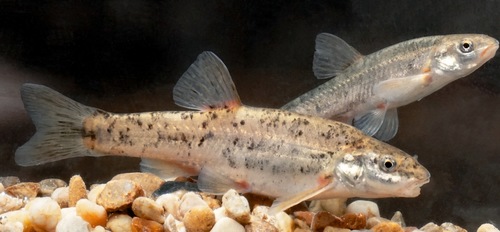
Speckled Dace
Rhinichthys osculus
The ultimate survivor of Western waters, the Speckled Dace is a master of adaptation found everywhere from desert springs to alpine creeks.
Quick Identification
Size
Small minnow reaching 5–10 cm (2–4 inches) in length; rarely exceeds 15 cm (6 inches).
Colors
Highly variable; typically olive, brownish, or gray on the back with a lighter cream belly. Characterized by dark spots (speckles) or a dark lateral stripe. Breeding males develop bright red or orange patches on the fins and base of the mouth.
Key Features
- Dark, irregular speckling across the body
- Pointed snout with a small, downward-facing mouth
- Small whisker-like barbel at the corners of the mouth
- Subtle dark stripe often running from snout to tail
When You’ll See Them
Geographic range
Where Does the Speckled Dace Live?
The Speckled Dace is native to the western half of the North American continent, boasting the widest distribution of any freshwater fish in the American West. Its core range extends from the river systems of British Columbia in Canada, south through the entire Western United States—including the Columbia, Colorado, and Sacramento River basins—and reaching as far south as the Sonora region in Mexico. While they are most abundant in their native cold-water streams, they have adapted to survive in isolated desert springs and high-altitude mountain creeks alike.
Basemap © OpenStreetMap contributors
Behavior
The Speckled Dace is a hardy and highly adaptable bottom-dweller, known for its ability to thrive in a vast array of water conditions. They spend much of their time darting between rocks and submerged vegetation, foraging for small organisms. While they are generally peaceful, they are active swimmers and can be seen moving in loose groups through riffles and shallow pools.
During the spawning season, usually in spring or early summer, their behavior becomes more animated as males compete for territory in gravel-bottomed areas. Despite being a common species, they are sensitive to heavy siltation and pollution, making them an excellent indicator of local stream health. They are rarely noticed by casual observers unless one looks closely into the clear shallows of a stream.
EverydayEarth exclusive
Camera Tips
To capture the Speckled Dace on camera, you will need a specialized underwater setup or a waterproof action camera like a GoPro. The best placement is in shallow 'riffles'—areas where water flows quickly over rocks—or in the calm pools immediately downstream of these ripples. Use a weighted small tripod or a flat 'bean bag' mount to keep the camera steady against the current at the bottom of the stream.
Natural lighting is critical for these small fish. Position your camera in a spot that receives plenty of midday sun, which will penetrate the water and highlight the 'speckled' patterns on their scales. Aim the lens horizontally across the gravel bed to catch them as they forage, or tilt it slightly upward to capture the light reflecting off their sides as they dart past.
While you shouldn't use food bait in natural waterways, you can attract Speckled Dace by gently disturbing a few rocks just upstream of your camera; this releases aquatic larvae and insects into the current, often triggering a feeding frenzy in front of your lens. Spring is the ideal time for filming, as the males' vibrant red breeding colors provide a stunning contrast against the grey river stones.
Similar Species
Species that look similar or are commonly confused with Speckled Dace.
Frequently Asked Questions
Record Speckled Dace at your habitat
Connect a camera to start building your own species record — AI identifies every visitor automatically.