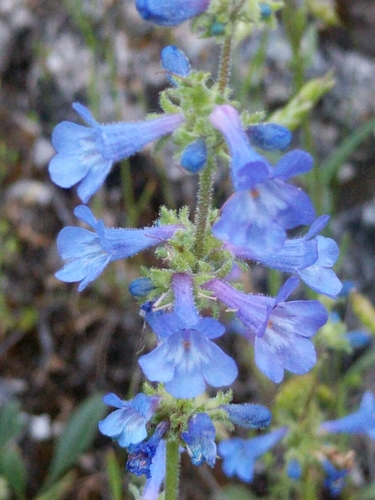
Low Beardtongue
Penstemon humilis
A pint-sized powerhouse of the Western high desert, the Low Beardtongue paints rocky slopes in brilliant shades of violet and azure. This resilient wildflower is a favorite stop for native bees and hummingbirds, making it a perfect low-profile target for your backyard nature cam.
Quick Identification
Size
Height ranges from 10–30 cm (4–12 inches); individual flowers are 1–1.5 cm (0.4–0.6 inches) long.
Colors
Vibrant sky blue to deep violet-purple flowers; often featuring white or pale lavender throats with delicate nectar guides; grayish-green foliage.
Key Features
- Tubular, two-lipped blue flowers with a prominent 'bearded' sterile stamen
- Low-growing growth habit with a persistent basal mat of leaves
- Opposite, lance-shaped leaves with a slightly waxy or hairy texture
When You’ll See Them
Behavior
Low Beardtongue is a hardy perennial that plays a vital role in the early summer ecosystem of the American West. Unlike taller, more aggressive garden varieties, this species stays close to the ground, forming tight mats of foliage that help retain soil moisture in arid environments. It is a slow-growing but persistent plant, often the first to colonize rocky outcrops or disturbed slopes where other vegetation struggles to take hold.
As a key nectar source, its 'behavior' is best observed through its relationship with local pollinators. The flower's tubular shape is perfectly evolved for long-tongued bees and small hummingbirds. When a pollinator enters the bloom, the 'beard' (a sterile, hairy stamen called a staminode) forces the insect to brush against the fertile stamens, ensuring efficient pollen transfer. While it doesn't move like an animal, its bloom cycle is highly responsive to spring moisture levels and temperature shifts.
EverydayEarth exclusive
Camera Tips
To capture the true beauty of Low Beardtongue and the wildlife it attracts, camera placement is everything. Because this species rarely exceeds a foot in height, you should mount your AI-powered camera on a ground-level spike or a very low tripod. Aim for a 'bug's eye view'—positioning the lens roughly 4 to 6 inches off the ground. This low angle allows you to look directly into the tubular flower throats, which is essential for the AI to identify visiting insects like mason bees or the occasional broad-tailed hummingbird.
Since this plant doesn't move, your camera's motion sensors will be triggered primarily by the pollinators it attracts. To maximize your 'hits,' choose a cluster of plants that is in full sun for at least six hours a day. High-speed shutter settings are your friend here; pollinators move fast, and a standard trail cam might only catch a blur. If your camera allows for 'burst mode,' enable it to capture the exact moment a bee enters the blossom. If you are using a feeder-style AI camera nearby, try to position the Low Beardtongue within the peripheral field of view to add a natural element to your captures.
Lighting is the biggest challenge with blue flowers, which can often look washed out or incorrectly colored in harsh midday sun. The best images usually occur during the 'golden hours'—shortly after sunrise or just before sunset—when the blue and violet pigments in the petals are most saturated. If your backyard is particularly windy, consider a camera with a high frame rate to counteract the 'sway' of the stems, which can cause focus-hunting issues for some AI models.
Finally, keep the area around the base of the plant clear of tall grass or debris that might obstruct the lens or cause false triggers on windy days. By focusing your camera on a healthy, multi-stemmed specimen, you increase the likelihood of capturing rare 'specialist' bees that only visit Penstemon species. Seasonal timing is critical; begin monitoring in late spring so you don't miss the relatively short 3-week peak blooming window when the plant is most active with wildlife.
Similar Species
Species that look similar or are commonly confused with Low Beardtongue.
Frequently Asked Questions
Record Low Beardtongue at your habitat
Connect a camera to start building your own species record — AI identifies every visitor automatically.