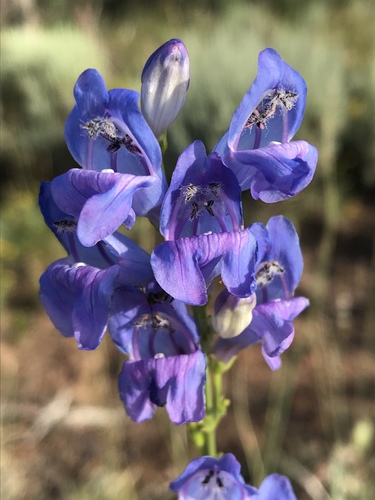
Rocky Mountain beardtongue
Penstemon strictus
With its towering spires of electric-blue blossoms, the Rocky Mountain beardtongue is the ultimate garden centerpiece for attracting hummingbirds and native bees.
Quick Identification
Size
Height: 30-90 cm (12-36 inches); Flower length: 2.5-3 cm (1 inch)
Colors
Vibrant violet-blue to deep purple petals; dark green, lance-shaped leaves; stems may have a reddish tint
Key Features
- Showy tubular flowers arranged primarily on one side of the stem
- Evergreen basal foliage that forms a low-growing mat
- Strictly upright, smooth flower stalks reaching up to 3 feet
- Sterile stamen (staminode) featuring fine, hair-like structures
When You’ll See Them
Behavior
The Rocky Mountain beardtongue is a resilient, long-lived perennial that serves as a cornerstone of the mountain meadow ecosystem. Known for its striking spikes of blue-purple flowers, this species is a primary destination for native pollinators. It is exceptionally well-adapted to the semi-arid conditions of the Western United States, showing remarkable resilience against cold winters and dry, rocky soils. Unlike some aggressive garden plants, it maintains a tidy, clump-forming habit and coexists peacefully with other native flora.
As a nectar-rich resource, it functions as a biological 'gas station' for long-tongued bees and hummingbirds. The common name 'beardtongue' refers to the sterile stamen hidden within the throat of the flower, which is often covered in tiny hairs. In a backyard habitat, this plant acts as a magnet for biodiversity, creating a hub of activity from late spring through mid-summer. While the plant itself is stationary, its role in supporting the local food web makes it a dynamic presence in any wildlife garden.
EverydayEarth exclusive
Camera Tips
When photographing Rocky Mountain beardtongue, your primary goal is often to capture the fast-moving pollinators it attracts, such as hummingbirds and bumblebees. For the best results, position your camera on a tripod at 'flower-spike height'—usually 18 to 24 inches above the ground. Angle the lens slightly upward to capture the blue-violet interior of the tubular blossoms. Because these tall stalks are prone to swaying in the breeze, use a camera with a fast shutter speed or a specialized 'action' trigger to prevent motion blur on windy days.
Hummingbirds are the most sought-after visitors for this species. To capture them mid-sip, set your camera to a high-speed burst mode or a motion-activated trigger with a very low latency. The best lighting occurs during the 'golden hours' of early morning (7:00 AM - 9:00 AM) when the nectar levels are at their peak and the sun highlights the iridescent quality of the blue petals. If your AI camera has 'Zone Selection,' focus the trigger area on the top third of the flower spikes where the newest blossoms are opening.
For an advanced project, try a time-lapse sequence to document the blooming process. A setting of one frame every 15-20 minutes over the course of a week will beautifully reveal how the flower spike 'unzips' from the bottom toward the top. In the autumn and winter, leave the dried stalks standing; they provide a striking architectural element in the snow and frequently attract small foraging birds looking for seeds, providing year-round camera activity.
Similar Species
Species that look similar or are commonly confused with Rocky Mountain beardtongue.
Frequently Asked Questions
Record Rocky Mountain beardtongue at your habitat
Connect a camera to start building your own species record — AI identifies every visitor automatically.