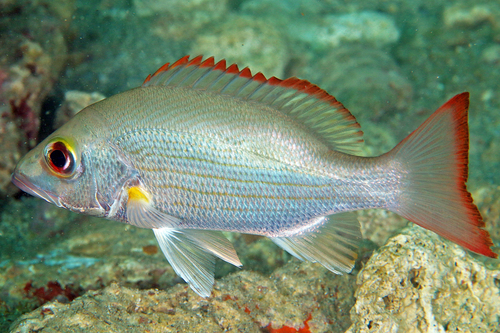
Mahogany Snapper
Lutjanus mahogoni
The Mahogany Snapper is a striking reef dweller known for its vibrant reddish hues and its signature 'ink blot' lateral spot. A master of the night, this elusive snapper is a favorite for underwater observers and coastal homeowners alike.
Quick Identification
Size
Typically 30-38 cm (12-15 inches) in length, reaching a maximum of 48 cm (19 inches). They generally weigh between 0.5 to 1.3 kg (1.1-2.9 lbs).
Colors
Silvery-white body with a distinct mahogany or reddish-brown tint, especially on the fins. Features a prominent, large black spot on the lateral line.
Key Features
- Large black spot centered on the lateral line
- Mahogany or reddish tint to the fins and back
- Distinctly notched preopercle (gill cover)
- Prominent large eyes for nocturnal hunting
When You’ll See Them
Geographic range
Where Does the Mahogany Snapper Live?
The Mahogany Snapper is native to the warm tropical and subtropical waters of the Western Atlantic Ocean. Its core range extends from the coastal waters of North Carolina through the Florida Keys, encompassing the entire Gulf of Mexico and the Caribbean Sea. These fish are also commonly found as far south as the northern coast of Brazil, thriving in clear reef environments throughout the Antilles and the Bahamas.
Basemap © OpenStreetMap contributors
Behavior
Mahogany Snappers are social, schooling fish during the day, often found hovering near coral heads, rocky ledges, or man-made structures like shipwrecks and docks. These daytime aggregations are primarily for protection against larger predators. While they appear relatively sedentary during the sunlight hours, they remain alert, using their large eyes to monitor their surroundings.
As dusk approaches, the schools break apart, and individuals become solitary, active hunters. They transition from the safety of the reef into nearby sandy flats and seagrass beds to forage. They are generally more cautious than other snapper species but can become accustomed to human presence in areas frequently visited by divers or near residential docks.
EverydayEarth exclusive
Camera Tips
To successfully capture a Mahogany Snapper on an underwater camera, placement is everything. These fish are 'structure-oriented,' meaning they rarely venture far into open water. Position your camera near dock pilings, submerged rock piles, or at the edge of a reef where it meets a sandy clearing. Mounting the camera 1-2 feet above the seabed, angled slightly upward, will help capture the characteristic silver flash of their scales and the distinct mahogany tint of their fins.
Since this species is most active after dark, your camera setup should ideally include infrared (IR) or low-intensity red LED lighting. Standard white lights can often startle these snappers or attract too many small baitfish, which creates 'backscatter'—a blizzard-like effect of particles that can ruin your footage. Red light is less visible to the fish and allows you to observe their natural hunting behavior without interference.
If you are monitoring a backyard dock or canal, try to time your observations with the incoming tide. Mahogany Snappers prefer clear, high-salinity water and will often move closer to shore as the tide brings in fresh ocean water. For the best AI detection, ensure your lens is kept clear of algae and barnacles, as the distinct black spot on the side of the fish is the primary visual marker the software will use to identify the species.
Similar Species
Species that look similar or are commonly confused with Mahogany Snapper.
Lane Snapper
Lane Snappers have distinct yellow horizontal stripes along their body and a smaller black spot that sits higher toward the back.
Gray Snapper
Also called Mangrove Snapper, they lack the prominent black spot and the reddish-mahogany color on their fins.
Mutton Snapper
Mutton Snappers have a much smaller black spot and a more pointed anal fin compared to the rounded fin of the Mahogany Snapper.
Frequently Asked Questions
Record Mahogany Snapper at your habitat
Connect a camera to start building your own species record — AI identifies every visitor automatically.