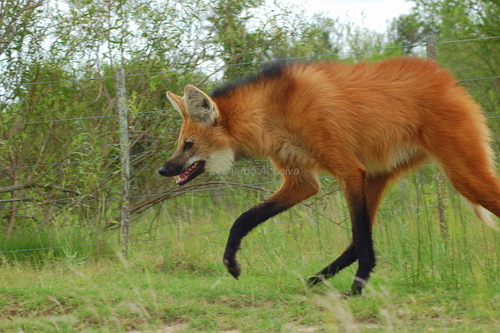
Maned Wolf
Chrysocyon brachyurus
The 'fox on stilts' of South America, the Maned Wolf is a solitary, fruit-eating canine that roams the golden grasslands of the Cerrado. With its striking black mane and stilt-like legs, it is one of the most evolutionarily distinct predators on the planet.
Quick Identification
Size
Standing about 90 cm (35 in) at the shoulder; length of 125-132 cm (49-52 in); weight 20-33 kg (44-73 lbs)
Colors
Golden-red body fur with a black mane, black legs ('stockings'), white throat, and a white-tipped tail
Key Features
- Extremely long, thin black legs adapted for tall grass
- Erectable black mane on the neck and shoulders
- Golden-red coat resembling a giant fox
- Large, upright ears nearly 7 inches tall
When You’ll See Them
Geographic range
Where Does the Maned Wolf Live?
Native to the heart of South America, the Maned Wolf is most commonly found in the vast Cerrado grasslands of central Brazil. Its range extends into the pampas of northern Argentina, the Chaco of Paraguay, and the savannas of eastern Bolivia. While they were historically found in parts of Uruguay and southern Peru, they are now considered extremely rare or nearly extinct in those regions.
Basemap © OpenStreetMap contributors
Behavior
Despite their name, Maned Wolves are not true wolves and do not form packs. They are remarkably solitary animals, interacting primarily during the breeding season. They are crepuscular, meaning they are most active during the dawn and dusk hours, though they may wander throughout the night. Unlike other canines that hunt in groups, the Maned Wolf uses its large ears to listen for prey in the grass and its long legs to see over the vegetation of the South American savanna.
These animals are quite shy and generally avoid human conflict, though they may occasionally venture near farms to hunt poultry if their natural habitat is encroached upon. They have a unique 'pacing' gait, moving both legs on the same side of the body simultaneously, which gives them a distinct, fluid movement through the tall Cerrado grasses. They are also known for their powerful scent, which is often compared to hops or cannabis, used to mark their vast territories.
EverydayEarth exclusive
Camera Tips
To capture the Maned Wolf on camera, you must account for its impressive height. Unlike most canids, these animals stand nearly three feet tall at the shoulder. Place your camera roughly 30 to 40 inches off the ground and angle it slightly upward if you are on a slope. Because of their long legs and tall stature, a wide-angle lens is preferred to ensure you don't just get a shot of their midsection as they pass by.
Maned Wolves are creatures of habit and often use established trails or dirt roads to patrol their territory. Look for tracks or their very distinct scat—which often contains the seeds of the wolf apple—to identify a high-traffic area. If you are in their native range, placing a camera near a fruiting 'Lobeira' (wolf apple) tree during the dry season is one of the most effective ways to guarantee a sighting, as these fruits are their primary food source.
Since they are primarily active at night and during twilight, a camera with high-quality infrared (no-glow) flash is essential. White flash can spook them, causing them to bolt and avoid the area in the future. Set your camera to take a burst of 3-5 photos or a 15-second video clip to capture their unique pacing gait, which is a hallmark of the species. Be patient, as their territories are massive, and a single individual may only pass a specific point once every few days.
Similar Species
Species that look similar or are commonly confused with Maned Wolf.
Frequently Asked Questions
Record Maned Wolf at your habitat
Connect a camera to start building your own species record — AI identifies every visitor automatically.