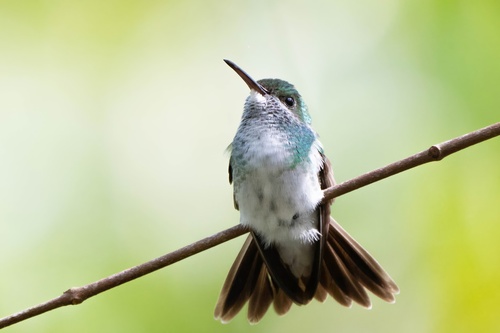
Mangrove Hummingbird
Chrysuronia boucardi
A glittering turquoise gem found only in the salty mangroves of Costa Rica, this endangered hummingbird is a masterpiece of coastal evolution.
Quick Identification
Size
9.5–11 cm (3.7–4.3 inches) in length; weight approximately 4.5g (0.16 oz)
Colors
Males feature a brilliant turquoise-green throat and breast with bronze-green upperparts; females have white underparts with light green spotting on the throat and sides.
Key Features
- Glittering blue-green gorget (throat) in males
- White belly and undertail coverts
- Bronze-green tail with a slight notch
- Strictly limited to Pacific mangrove ecosystems
When You’ll See Them
Geographic range
Where Does the Mangrove Hummingbird Live?
Native to the lush Pacific coastline of Central America, the Mangrove Hummingbird is a rare specialist found exclusively in Costa Rica. Its core range is extremely restricted, hugging the muddy shores and tangled roots of the Nicoya Peninsula, the Gulf of Nicoya, and south to the Golfo Dulce. Unlike many tropical birds that roam across borders, this species never ventures inland or away from its native mangrove stands, making it one of the most geographically limited hummingbirds in the world.
Basemap © OpenStreetMap contributors
Behavior
The Mangrove Hummingbird is a specialized and highly territorial species. They are rarely seen far from the Pacific coast, where they defend patches of flowering mangroves with surprising aggression for their small size. Like most hummingbirds, they are high-energy flyers, spending a significant portion of their day hovering to feed or darting between perches to survey their territory.
These birds have a particularly close relationship with the Tea Mangrove tree. During the breeding season, which typically aligns with the dry months, males can be seen performing aerial displays or singing from high, exposed perches to attract mates. They are generally solitary except when mating or when multiple birds gather near a particularly rich nectar source, though they remain competitive and will chase away rivals and even larger bird species.
EverydayEarth exclusive
Camera Tips
To capture the Mangrove Hummingbird, your camera placement must be highly strategic. Look for the distinctive large, tea-colored flowers of the Tea Mangrove (Pelliciera rhizophorae). Mount your camera on a sturdy branch or a tripod roughly 4 to 6 feet above the ground, facing a cluster of fresh blooms. Because these birds move with incredible speed, use a camera with a 'Fast' or 'Ultra' trigger speed—ideally under 0.2 seconds—to ensure you don't just capture a blur of wings or an empty frame.
Lighting is the most critical factor for bringing out the iridescent turquoise throat of the male. Position your camera so the sun is behind it, illuminating the bird's front as it hovers at the flowers. If your camera allows for video, set it to the highest possible frame rate (60fps or higher) and use a 4K resolution. This allows you to slow down the footage afterward to see the mechanics of their flight, which is otherwise too fast for the human eye to process.
Since this species lives in intertidal zones, always be mindful of the tides. Ensure your equipment is waterproof and positioned high enough to avoid being submerged during high tide or splashed by brackish water, which can corrode electronics. Avoid using artificial feeders in these sensitive ecosystems; instead, focus on the 'natural bait' of their preferred flowering trees. Check your camera early in the morning, as the first two hours of light provide the most consistent feeding activity.
Similar Species
Species that look similar or are commonly confused with Mangrove Hummingbird.
Blue-vented Hummingbird
Found in more varied habitats including gardens and dry forests; has a blue-tinged vent and slightly different gorget shade.
Snowy-bellied Hummingbird
Features much more extensive, bright white underparts and often inhabits edges of wet forests rather than salt-water mangroves.
Frequently Asked Questions
Record Mangrove Hummingbird at your habitat
Connect a camera to start building your own species record — AI identifies every visitor automatically.