Mangrove Kingfisher
Halcyon senegaloides
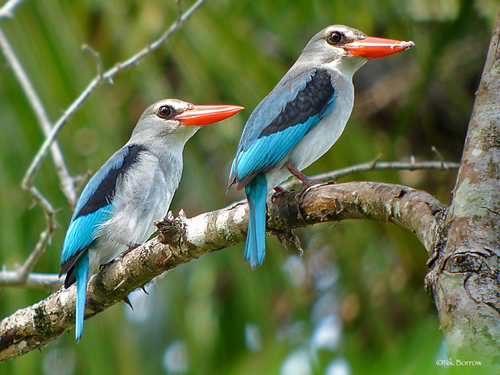
A vibrant coastal specialist, the Mangrove Kingfisher is easily identified by its stunning cobalt wings and a heavy, blood-red bill used for snatching crabs from the mud.
Quick Identification
Size
Length: 22 cm (8.7 in); Weight: 50–80 g (1.8–2.8 oz)
Colors
Bright cobalt blue wings and tail; greyish-white head and underparts; entirely bright red bill; black wing coverts.
Key Features
- Entirely bright red bill (no black)
- Cobalt blue wings and tail
- Greyish-white head and underparts
- Dark streak through the eye
- Stocky build, roughly 8.7 inches long
When You’ll See Them
Geographic range
Where Does the Mangrove Kingfisher Live?
The Mangrove Kingfisher is a specialist of the eastern African coastline. It is natively found from southern Somalia through Kenya, Tanzania, and Mozambique, extending as far south as the Eastern Cape of South Africa. While it is primarily a resident in the northern parts of its range, some southern populations exhibit seasonal movement, though it remains strictly tied to the brackish and saltwater margins of the Indian Ocean.
Basemap © OpenStreetMap contributors
Behavior
The Mangrove Kingfisher is a classic 'perch-and-pounce' predator. It spends much of its day sitting motionless on a low-hanging branch over water or mudflats, scanning the ground for movement. Despite its bright colors, it can be surprisingly difficult to spot until it suddenly darts down to seize a crab or fish. Unlike some of its more social kingfisher cousins, this species is largely solitary or found in pairs, maintaining a well-defined territory along the water's edge.
These birds are highly vocal, especially during the breeding season. Their call is a loud, ringing 'ki-ti-ti-ti' that descends in pitch, often serving as the first sign of their presence in dense mangrove thickets. While they are wary of direct human approach, they have adapted well to coastal suburban gardens that provide high perches and clear views of foraging ground.
EverydayEarth exclusive
Camera Tips
To capture a Mangrove Kingfisher on a backyard or trail camera, focus your efforts on 'high-traffic' perches. These birds love horizontal branches that hang roughly 2 to 5 meters above a mudflat, creek, or garden pond. Position your camera at eye level with the branch rather than aiming up from the ground to get the best detail of their vibrant plumage and red bill. Because they sit still for long periods, use a high-sensitivity motion trigger or a time-lapse mode to ensure you don't miss the moment they land.
Lighting is your biggest challenge in mangrove environments. The thick canopy often creates harsh shadows and bright hotspots. If possible, angle your camera to face south (in the southern hemisphere) to avoid direct sun flare, and set your camera to a fast shutter speed or 'Sports' mode if available, as their strike at prey is lightning-fast and can easily result in motion blur.
If you are in a coastal suburban area, you can attract them to your camera's view by providing a clear 'hunting stage.' A patch of exposed mud or a shallow water feature at the edge of your property can be a magnet for these birds. They are particularly active during the falling tide when crabs are most exposed, so if your camera allows for scheduled recording, sync it with the local tide tables for the best results.
Similar Species
Species that look similar or are commonly confused with Mangrove Kingfisher.
Woodland Kingfisher
The Woodland Kingfisher has a distinctive black lower mandible and a black patch on the wing coverts, whereas the Mangrove's bill is all red.
Brown-hooded Kingfisher
This species has a brownish head and streaked breast, lacking the clean grey-white head and bright blue wings of the Mangrove Kingfisher.
Frequently Asked Questions
Record Mangrove Kingfisher at your habitat
Connect a camera to start building your own species record — AI identifies every visitor automatically.