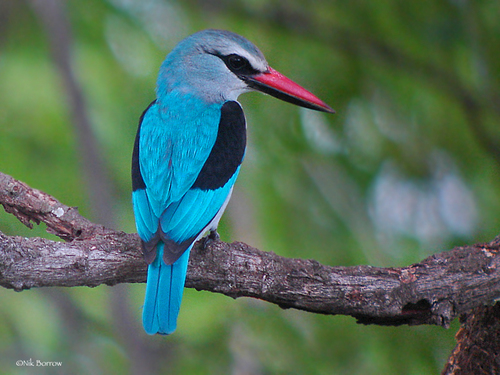
Woodland Kingfisher
Halcyon senegalensis
A flash of electric blue and a piercing, trilling song announce the arrival of the Woodland Kingfisher. This bold, charismatic bird is a favorite for backyard observers across Africa, known for its dramatic dives and striking red-and-black bill.
Quick Identification
Size
Length: 20-24 cm (8-9.5 in); Wingspan: 35-40 cm (14-16 in); Weight: 40-65 g (1.4-2.3 oz)
Colors
Brilliant electric blue back, wings, and tail; white underparts; black wing-shoulders; red upper mandible and black lower mandible; black stripe through the eye.
Key Features
- Distinctive two-toned bill (bright red top, jet black bottom)
- Vibrant iridescent blue plumage on the wings and back
- Black 'shoulders' visible when perched
- Loud, piercing trilling call that drops in pitch
When You’ll See Them
Geographic range
Where Does the Woodland Kingfisher Live?
The Woodland Kingfisher is a quintessentially African species, widely distributed across sub-Saharan Africa. Its native range spans from Senegal in the west to Ethiopia and Eritrea in the east, extending southwards through the Congo Basin to the northern parts of South Africa, Namibia, and Botswana. While populations near the equator are often year-round residents, those in the southern and northern extremes of the range are migratory, arriving in regions like the Transvaal or the Sahel only during the wet summer months to breed.
Basemap © OpenStreetMap contributors
Behavior
The Woodland Kingfisher is a highly territorial and vocal bird, famous for its loud, ringing call that serves as a hallmark of the African summer. Unlike many other kingfisher species, it is not strictly tied to water; it is a 'tree kingfisher' that spends much of its time perched on high, exposed branches or telephone wires, scanning the ground for prey. When it spots a meal, it performs a swift, acrobatic dive to snatch the target before returning to its perch.
These birds are intra-African migrants, meaning they move within the continent to follow the rainy seasons. They are known for a spectacular wing-spreading display during territorial disputes or courtship, where they flash their brilliant blue underwing coverts. While they are generally solitary or found in pairs, they can be quite bold around human settlements, frequently visiting suburban gardens with large trees and open lawns.
EverydayEarth exclusive
Camera Tips
To capture the stunning blue of a Woodland Kingfisher, your camera placement is everything. These birds are 'sit-and-wait' predators that prefer high, horizontal vantage points with a clear view of the ground. Position your AI camera to face a prominent, bare branch or a fence post about 2 to 4 meters (6 to 13 feet) off the ground. If you have a backyard pool or a large bird bath, this is a prime spot; despite being land-hunters, they love to 'plunge-bathe' to clean their feathers and will often return to the same branch to dry off afterward.
Because the Woodland Kingfisher is incredibly fast when it strikes, you should set your camera to its highest trigger sensitivity. If your camera supports a 'pre-roll' or 'pre-buffer' feature, enable it; this ensures you catch the moment they leave the perch rather than just an empty branch. Since they are most active during the brighter parts of the morning and late afternoon, ensure your camera isn't facing directly into the sun to avoid washing out those brilliant iridescent blues.
If you are trying to attract them to a specific spot, maintaining a patch of short-mown grass or a clear garden floor near a tall tree is effective, as it makes it easier for them to spot insects. During the breeding season (mid-summer), they often use old woodpecker or barbet holes in trees. Placing a camera near a known nesting cavity in a dead tree trunk can provide intimate footage of their family life, but be sure to maintain a respectful distance to avoid disturbing the brood.
Similar Species
Species that look similar or are commonly confused with Woodland Kingfisher.
Mangrove Kingfisher
The Mangrove Kingfisher has an all-red bill, whereas the Woodland Kingfisher's lower mandible is jet black.
Brown-hooded Kingfisher
Lacks the vibrant electric blue on the head and back, featuring a streaked brown head and a more subdued blue on the wings and tail.
Malachite Kingfisher
Much smaller in size (about half the length) and always found very close to water sources.
Frequently Asked Questions
Record Woodland Kingfisher at your habitat
Connect a camera to start building your own species record — AI identifies every visitor automatically.