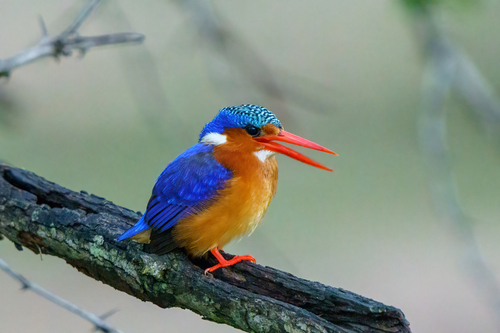
Malachite Kingfisher
Corythornis cristatus
The Malachite Kingfisher is a dazzling jewel of the African waterways, recognizable by its brilliant metallic blue plumage and striking orange-red bill. A master of the 'sit-and-wait' hunting technique, this tiny bird adds a flash of iridescent color to any garden pond or riverbank.
Quick Identification
Size
Length: 13 cm (5.1 in); Wingspan: 18-19 cm (7.1-7.5 in); Weight: 12-19 g (0.4-0.7 oz)
Colors
Brilliant metallic blue upperparts; rich orange-rufous underparts; white patches on the sides of the neck and throat; adult bills are bright red while juveniles have blackish bills.
Key Features
- Erectile crest of turquoise-blue and black feathers
- Vibrant orange-red bill in adults
- Short tail and disproportionately large head
- White patch on the side of the neck
When You’ll See Them
Geographic range
Where Does the Malachite Kingfisher Live?
The Malachite Kingfisher is a quintessential African species, native to nearly the entire continent south of the Sahara Desert. Its core range extends from the wetlands of West Africa across the Congo Basin and East African rift lakes down to the southern tip of South Africa. While it is a resident in most areas, it may perform local movements during dry seasons to find permanent water sources.
Basemap © OpenStreetMap contributors
Behavior
The Malachite Kingfisher is a solitary and highly territorial hunter, often seen perched motionless on reeds or low-hanging branches just inches above the water's surface. From this vantage point, it scans the water for movement with incredible precision. Once prey is spotted, it performs a sudden, vertical dive, submerging briefly before returning to its perch to stun its catch against a branch and swallow it headfirst.
Despite their bright colors, they can be surprisingly difficult to spot until they move, as they often sit in the dappled shade of overhanging vegetation. When they fly, they move in a direct, rapid manner, staying low over the water like a shimmering blue streak. While they are generally shy around humans, they are frequent visitors to quiet suburban garden ponds where fish or frogs are present.
EverydayEarth exclusive
Camera Tips
To capture the Malachite Kingfisher on camera, you must focus on 'perch hunting.' Identify a thin, stable branch or a reed that hangs roughly 20 to 50 centimeters over a pond or slow-moving stream. These birds are creatures of habit and will return to the same favorite fishing spot dozens of times a day. Mount your camera at eye level with the perch, approximately 1.5 to 2 meters away to get a clear, detailed shot without triggering the bird's flight response.
Lighting is your biggest challenge and greatest ally. Because the Malachite Kingfisher has highly reflective metallic feathers, direct midday sun can cause 'blown out' highlights. Aim to position your camera so the sun is behind it during the early morning or late afternoon. This 'golden hour' light brings out the deep orange of the breast and the iridescent sparkle of the malachite crest beautifully. Ensure your camera's trigger speed is set to the fastest possible mode, as their dives are lightning-quick.
If you are using an AI-powered camera in a backyard setting, a small garden pond is the perfect lure. You do not need artificial bait; a healthy population of tadpoles or small feeder fish will naturally attract them. Keep the area around the perch clear of distracting moving grass that might cause false triggers. In the summer months, they are particularly active, and if you are lucky, you may capture the 'wing-flicking' display they use during territorial disputes or courtship.
Similar Species
Species that look similar or are commonly confused with Malachite Kingfisher.
African Pygmy Kingfisher
Smaller with a violet wash on the ear coverts and a less prominent crest that doesn't reach the bill.
Half-collared Kingfisher
Larger with a black bill (even in adults) and lacks the orange-rufous underparts of the Malachite.
Shining-blue Kingfisher
Darker blue overall with a black bill and much darker, less orange underparts; prefers deep forest streams.
Frequently Asked Questions
Record Malachite Kingfisher at your habitat
Connect a camera to start building your own species record — AI identifies every visitor automatically.