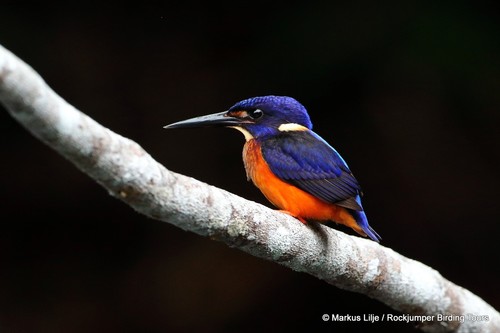
Shining-blue Kingfisher
Alcedo quadribrachys
A jewel of the African rainforest, the Shining-blue Kingfisher is a master of the shaded stream. With its brilliant sapphire plumage and lightning-fast dives, this elusive bird is a prize for any wildlife enthusiast's camera.
Quick Identification
Size
Length: 16 cm (6.3 inches); Weight: 25–42 g (0.88–1.48 oz)
Colors
Brilliant ultramarine or royal blue upperparts; rich chestnut-orange underparts; white patches on the throat and side of the neck; black bill; bright red legs and feet.
Key Features
- Deep shimmering blue back and wings
- Rich chestnut-orange underparts
- Large, straight black dagger-like bill
- Small white neck and throat patches
- Absence of a prominent crest compared to malachite kingfishers
When You’ll See Them
Geographic range
Where Does the Shining-blue Kingfisher Live?
Native to the lush tropical heart of the African continent, the Shining-blue Kingfisher thrives across a wide belt of West and Central Africa. Its territory stretches from the coastal forests of Senegal and Guinea, through the Congo Basin, and as far east as western Uganda and northern Zambia. This species is a true specialist of the African equatorial forest zone, rarely straying far from permanent, slow-moving water sources within primary or secondary rainforests.
Basemap © OpenStreetMap contributors
Behavior
The Shining-blue Kingfisher is a secretive and primarily solitary bird, often described as a 'jewel of the shadows.' Unlike more visible kingfisher species that hunt in open wetlands, this species prefers the deep shade of overhanging vegetation along narrow forest streams. It is a patient hunter, spending long periods perched motionless on low-hanging branches just a meter or two above the water's surface, scanning for movement below.
When prey is spotted, it performs a swift, vertical plunge-dive, submerging briefly before returning to its perch to deal with its catch. These birds are highly territorial, defending specific stretches of a stream from rivals. While they are usually quiet, they may emit a high-pitched, piping call when startled or during territorial disputes. They are generally wary of humans and will quickly fly low over the water to a new hiding spot if approached.
EverydayEarth exclusive
Camera Tips
To capture the Shining-blue Kingfisher, location is everything. Scout for narrow, slow-moving forest streams with low-hanging, horizontal branches that provide a clear view of the water. These birds have favorite 'fishing perches' that they return to repeatedly. Position your AI-powered camera approximately 2 to 4 meters from a suspected perch, ensuring the lens is angled slightly downward toward the water to catch the dive action as well as the bird in profile.
Because these birds inhabit shaded environments, lighting can be a challenge. If your camera allows, prioritize a higher ISO or a fast shutter speed setting to freeze the motion of their rapid dives. Using a camera with a high-quality PIR (passive infrared) sensor is vital, as the bird's small size and fast movement can sometimes fail to trigger lower-end models. Avoid using bright white flashes at night if you are also monitoring for mammals in the same area, but during the day, natural dappled light is your best friend.
Baiting is generally not recommended for this species, as they prefer live, moving prey in the water. However, you can 'landscape' a potential area by placing a perfect, moss-covered branch in a strategic spot over a pool in the stream. If it provides a better vantage point than the surrounding branches, the kingfisher will likely adopt it as a regular hunting station. Be patient, as these birds are shy; leave your camera in place for at least two weeks to allow the bird to become accustomed to its presence.
Similar Species
Species that look similar or are commonly confused with Shining-blue Kingfisher.
Malachite Kingfisher
Smaller with a distinct turquoise crest and much lighter, more electric-blue plumage.
African Pygmy Kingfisher
Much smaller and primarily terrestrial, feeding on insects in the forest rather than diving for fish.
Half-collared Kingfisher
Has a blue-and-black bill and a distinct blue 'half-collar' on the sides of the breast.
Frequently Asked Questions
Record Shining-blue Kingfisher at your habitat
Connect a camera to start building your own species record — AI identifies every visitor automatically.