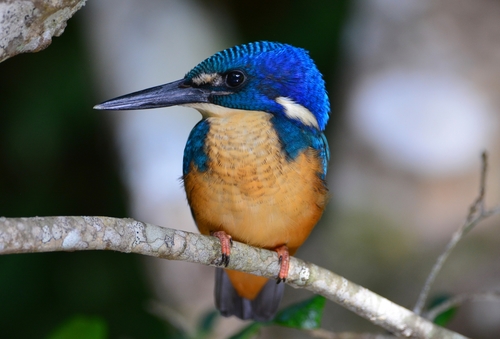
Half-collared Kingfisher
Alcedo semitorquata
A cobalt jewel of the African riverbank, the Half-collared Kingfisher is a master of the precision dive. Recognized by its striking blue-and-white plumage, this elusive bird is the ultimate prize for backyard observers with flowing water nearby.
Quick Identification
Size
Length of 18–20 cm (7–8 inches); weight between 35–45 g (1.2–1.6 oz)
Colors
Brilliant cobalt-blue upperparts, creamy-white throat and belly, with blue patches on the sides of the neck forming the 'half-collar'. Males have an entirely black bill, while females often show a touch of red at the base of the lower mandible.
Key Features
- Distinct blue patches on the sides of the neck
- Brilliant cobalt-blue back and wings with turquoise speckling on the head
- Sharp, dagger-like black bill
- Bright orange-red legs and feet
When You’ll See Them
Geographic range
Where Does the Half-collared Kingfisher Live?
The Half-collared Kingfisher is a native resident of the African continent, primarily distributed across Eastern and Southern Africa. Its core range extends from the highlands of Ethiopia down through the river systems of Kenya, Tanzania, and Zambia, reaching its most consistent populations in South Africa, Zimbabwe, and Mozambique. While it is not found in the arid west, it thrives wherever permanent, clear water flows through wooded or forested terrain.
Basemap © OpenStreetMap contributors
Behavior
The Half-collared Kingfisher is a shy and largely solitary bird, often described as the 'quiet specialist' of the African river systems. Unlike its more boisterous cousins, this species prefers the seclusion of shaded, fast-flowing streams and well-vegetated riverbanks. It spends much of its day perched motionless on low-hanging branches, intently scanning the water for movement before launching into a precise, vertical dive.
Highly territorial, individuals will defend a specific stretch of water year-round, patrolling their borders with low, fast flights just inches above the water's surface. While they are generally wary of humans, they can become accustomed to quiet observers if their favorite hunting perches are left undisturbed. Their presence is often announced by a sharp, high-pitched 'peep-peep' call as they dart away into cover.
EverydayEarth exclusive
Camera Tips
To capture the Half-collared Kingfisher on an AI-powered camera, placement is everything. These birds are creatures of habit and will use the same 'fishing perch' for days on end. Look for horizontal branches or reeds that overhang clear water at a height of 0.5 to 1.5 meters. Mount your camera at the same height as the perch, ideally 2-3 meters away, to ensure the bird is in focus without triggering its shy nature. A side-on angle is best to capture the namesake 'half-collar' and the brilliant blue of the back.
Lighting is your biggest challenge under dense riverine canopies. Position the camera facing south (in the southern hemisphere) to avoid lens flare, and try to catch the morning sun as it hits the water's edge. Because kingfishers move with incredible speed during a dive, use a camera with a fast trigger speed (0.2 seconds or less) or set your device to record short 10-second video clips to capture the dramatic entry and exit from the water.
While you cannot easily 'bait' a kingfisher with seed, you can attract them by providing the perfect habitat. If you have a backyard stream or pond, ensuring the water is clear and stocked with small indigenous fish is the best lure. Avoid using artificial perches that look out of place; instead, prune a natural branch to lean over a deeper pool where fish congregate. Patience is key, as these birds may only visit a specific perch once or twice a day during their patrol.
Similar Species
Species that look similar or are commonly confused with Half-collared Kingfisher.
Malachite Kingfisher
Much smaller with a bright red bill and orange underparts, whereas the Half-collared has a black bill and white underparts.
Shining-blue Kingfisher
Found in West/Central Africa; it lacks the white half-collar and has more uniform blue underparts.
Pied Kingfisher
Strictly black and white with no blue plumage; often hovers over water, which the Half-collared rarely does.
Frequently Asked Questions
Record Half-collared Kingfisher at your habitat
Connect a camera to start building your own species record — AI identifies every visitor automatically.