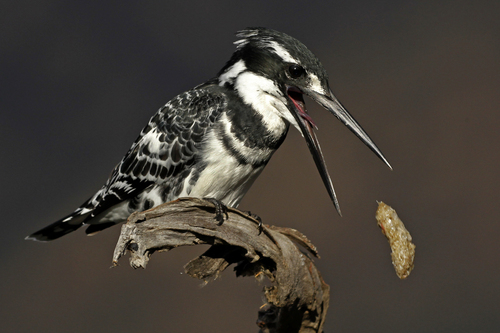
Pied Kingfisher
Ceryle rudis
A master of the hover and dive, the Pied Kingfisher is a monochrome marvel that turns every fishing trip into an acrobatic display. With its striking black-and-white patterns and bold spiky crest, it is one of the most charismatic birds you'll find near the water's edge.
Quick Identification
Size
25–29 cm (10–11.5 in) in length; wingspan of 45–47 cm (18 in); weighs 70–100g (2.5–3.5 oz)
Colors
Bold black and white checkered plumage, white underparts, and a black crest. Males have two black breast bands (one thick, one thin); females have a single, often broken, breast band.
Key Features
- Distinctive black and white mottled plumage
- Prominent spiky black crest
- Vertical hovering behavior over water
- Male has double breast band; female has a single broken band
- Frequent head bobbing and tail flicking when perched
When You’ll See Them
Sightings on EverydayEarth
Jul 4, 2026
A group of hippopotamuses is gathered at a watering hole. Several individuals are partially submerged in the center of the pool, while two are resting on the far right bank. An Egyptian Goose perches on a fallen branch on the left, and a Pied Kingfisher is also visible perching near the water's edge before moving.
Jul 3, 2026
A pod of hippopotamuses is resting in a woodland watering hole, with several individuals surfacing to breathe and shift positions. On the left side of the pool, a Pied Kingfisher is perched on a piece of submerged driftwood before it takes flight and moves across the water's surface.
Jul 2, 2026
In the bright morning light at a Laikipia watering hole, a Common Hippopotamus remains mostly submerged on the left side of the frame, with only its head and back breaking the surface. On the rocky outcroppings to the right, several Egyptian Geese are perched, while two Pied Kingfishers occupy a fallen log in the center of the water. The birds are seen moving and adjusting their positions on the rocks and log throughout the sequence.
Jul 2, 2026
Several hippopotamuses are submerged in a watering hole, resting and occasionally twitching their ears or shifting position. A small bird is perched on a partially submerged branch on the left side of the pond, and another flies quickly across the frame.
Jul 1, 2026
A group of hippopotamuses is resting mostly submerged in the river, huddled around some large rocks. A Pied Kingfisher is perched on a fallen log in the water to the left before it eventually takes flight. Further back, a Black-headed Heron stands still on the rocks, likely scanning for prey in the water.
Jul 1, 2026
Several Common Hippopotamuses are resting in the water, with their backs and heads partially submerged near large rocks in the riverbed. A Pied Kingfisher flies across the frame and hovers briefly over the water's surface, likely hunting. Other small birds are perched on fallen logs and rocks throughout the scene.
Geographic range
Where Does the Pied Kingfisher Live?
The Pied Kingfisher claims an expansive territory spanning two continents, thriving across sub-Saharan Africa and throughout much of Southern and Southeast Asia. It is a common sight from the banks of the Nile in Egypt to the tropical wetlands of India, Vietnam, and Southern China. While it is predominantly a resident species within its range, it may move locally in response to water level changes or seasonal food availability, though it rarely ventures far from stable water sources.
Basemap © OpenStreetMap contributors
Behavior
The Pied Kingfisher is a highly social and specialized hunter, often seen in pairs or small family groups. Unlike many other kingfishers that must hunt from a stationary perch, this species is famous for its ability to hover stationary in mid-air over open water, searching for prey. This unique hovering ability allows them to hunt in large lakes or coastal waters where perches are unavailable, making them more versatile than their cousins.
Once a target is spotted, the bird performs a dramatic vertical dive to catch its meal. They are quite vocal, frequently announcing their presence with a sharp, twittering 'chirruk' call. They are relatively comfortable around human activity and are often found near jetties, canals, and garden ponds as long as there is a steady supply of fish. When perched, they exhibit a characteristic behavior of bobbing their heads and flicking their tails up and down.
EverydayEarth exclusive
Camera Tips
To capture the best images of a Pied Kingfisher, position your camera near a known 'fishing perch.' Look for dead branches, reeds, or man-made structures like dock railings that extend over clear water. These birds are creatures of habit and will often return to the same spot multiple times a day to scan the water. Angle your camera to be at eye level with the perch, or slightly below, to capture the dramatic silhouette of their spiky crest against the sky or water.
Because Pied Kingfishers are incredibly fast when diving and hovering, camera settings are crucial. Use a high shutter speed—ideally 1/2000 of a second or faster—to freeze the motion of their wings during a hover. If your AI camera has a 'bird' or 'fast motion' mode, ensure it is enabled to reduce trigger lag. Video mode is often more rewarding for this species than still photography, as it captures the unique head-bobbing and tail-flicking behaviors that a single frame might miss.
If you have a backyard pond, you can attract them by ensuring there is a clear, stable perch about 1 to 2 meters above the water surface. They are not attracted to traditional bird feeders, but a healthy population of small ornamental fish (like goldfish or minnows) in a pond will act as a natural lure. Early morning light provides the best illumination for their white plumage; avoid harsh midday sun which can 'blow out' the white details in their feathers. If using a trail camera, a side-on angle to the water's surface can capture the moment they emerge from a dive with a fish.
Similar Species
Species that look similar or are commonly confused with Pied Kingfisher.
Frequently Asked Questions
Record Pied Kingfisher at your habitat
Connect a camera to start building your own species record — AI identifies every visitor automatically.