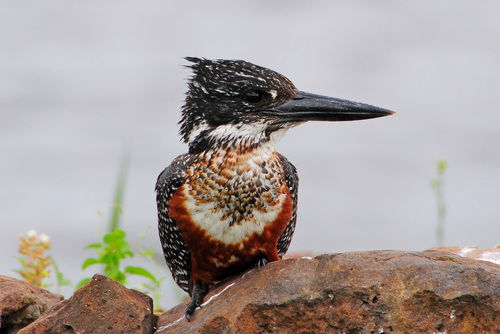
Giant Kingfisher
Megaceryle maxima
The largest kingfisher on the African continent, this striking bird is a master of the 'sit-and-wait' hunting technique. With its shaggy crest and massive bill, the Giant Kingfisher is a magnificent sight for any waterside observer.
Quick Identification
Size
Length 42–48 cm (16.5–19 in); Wingspan 72–75 cm (28.3–29.5 in); Weight 255–425 g (9–15 oz)
Colors
Slaty gray upperparts with fine white spots; Males have a chestnut upper breast and white belly; Females have a white-spotted black upper breast and chestnut belly
Key Features
- Massive, dagger-like black bill
- Large, shaggy crest on head
- Slaty gray/black plumage with dense white speckling
- Distinctive 'kek-kek-kek' loud cackling call
When You’ll See Them
Geographic range
Where Does the Giant Kingfisher Live?
The Giant Kingfisher is native to the African continent, where it is a common resident across almost all of Sub-Saharan Africa. Its core range extends from the West African coast through Central Africa to Ethiopia, and down into South Africa. It is conspicuously absent from the extremely arid regions of the southwest, such as the Namib and Kalahari deserts, as it requires permanent water bodies for survival.
Basemap © OpenStreetMap contributors
Behavior
The Giant Kingfisher is a solitary and highly territorial bird, often seen perched motionless for long periods on branches overhanging water. Despite its size, it can be surprisingly unobtrusive until it lets out its loud, rhythmic cackling call, which often sounds like a harsh laugh. They are diurnal hunters, spending much of their day scanning the water from a favored 'killing perch' before plunging headfirst to snatch prey.
While they are generally wary of humans, they have adapted well to suburban environments that feature large garden ponds or proximity to rivers. They are not social birds outside of the breeding season; pairs will defend a stretch of river vigorously against intruders. Their flight is strong and direct, usually low over the water surface, characterized by steady, rhythmic wingbeats.
EverydayEarth exclusive
Camera Tips
To capture a Giant Kingfisher on your backyard or trail camera, the most critical factor is identifying their 'primary perch.' These birds are habitual and will return to the same branch overhanging a pond or river day after day. Position your camera 5–10 feet away from a known perching branch, ideally at the same height as the branch to get an eye-level profile. Using a side-on angle rather than a direct frontal view will better showcase their impressive crest and massive bill.
Because these birds are incredibly fast when diving, set your camera to 'Burst Mode' or, better yet, high-definition video. A trigger speed of 0.2 to 0.5 seconds is ideal to catch the moment they return to the perch with a fish. If you are using a pond as a lure, ensure there is a clear, unobstructed flight path for the bird to enter and exit. They prefer perches that are 1–3 meters above the water surface with a clear view of the depths below.
Lighting is key when photographing their dark, slaty plumage. Position the camera with the sun at your back to illuminate the white spotting and the chestnut breast of the male or belly of the female. Avoid pointing the camera directly at highly reflective water, as the glare can cause false triggers or wash out the image. Early morning and late afternoon provide the best natural light and coincide with their peak hunting activity.
Similar Species
Species that look similar or are commonly confused with Giant Kingfisher.
Frequently Asked Questions
Record Giant Kingfisher at your habitat
Connect a camera to start building your own species record — AI identifies every visitor automatically.