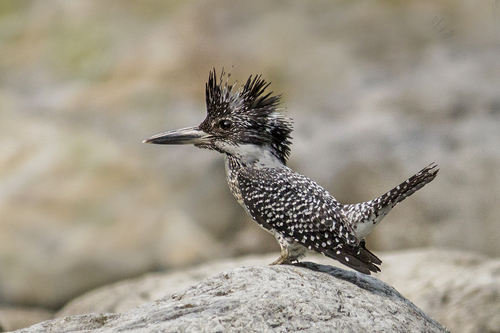
Crested Kingfisher
Megaceryle lugubris
A monochrome masterpiece of the avian world, the Crested Kingfisher is one of Asia's largest and most striking river specialists. With its shaggy crest and expert diving skills, it is the undisputed king of the mountain stream.
Quick Identification
Size
41–43 cm (16–17 in) in length with a wingspan of approximately 65–75 cm (25–29 in); weighs 230–380 g (8.1–13.4 oz).
Colors
Strikingly monochrome with black and white barred upperparts and a white collar. Males feature a white breast with fine black spotting, while females are distinguished by rufous (reddish-brown) underwing coverts.
Key Features
- Prominent shaggy, spiked crest
- Massive, straight black bill
- Bold black and white barred plumage
- Large, crow-sized body
- Distinctive white neck ring
When You’ll See Them
Geographic range
Where Does the Crested Kingfisher Live?
The Crested Kingfisher is a magnificent resident of the Asian continent, primarily found across the rugged landscapes of Southern and Eastern Asia. Its core range spans from the Himalayan foothills in Pakistan, India, and Nepal, stretching eastward through Central and Southern China into the islands of Japan and the Korean Peninsula. In Southeast Asia, it is a localized resident in the highland river systems of Vietnam, Laos, and Thailand, though it generally avoids the low-lying tropical plains of the deep south.
Basemap © OpenStreetMap contributors
Behavior
The Crested Kingfisher is a stoic and imposing presence along Asian waterways. Unlike its smaller, more frantic relatives, this kingfisher often spends long periods sitting perfectly still on a favored 'sentinel' perch—usually a large rock in the middle of a stream or a branch overhanging a deep pool. It is highly territorial and will patrol a specific stretch of river, announcing its presence with a loud, metallic 'plick' call that carries over the sound of rushing water.
When it spots prey, the Crested Kingfisher exhibits remarkable focus, sometimes hovering briefly before committing to a powerful vertical plunge. They are generally solitary birds outside of the breeding season, but pairs work closely together to excavate deep nesting tunnels in vertical riverbanks. While they are wary of human disturbance, they are known to tolerate observers who remain still, making them a rewarding subject for patient backyard or trail camera enthusiasts living near suitable habitats.
EverydayEarth exclusive
Camera Tips
Capturing a Crested Kingfisher requires understanding their daily routine. These birds are incredibly habitual, often returning to the exact same rock or branch every morning to hunt. Scan your local river for boulders that sit in the middle of the current or branches that offer a clear view of a slow-moving pool. Mounting your camera on a sturdy tripod weighted with sandbags, or using a tree strap on a nearby trunk, will provide the stability needed for high-quality shots.
Because these birds are large, you don't need to be right on top of them; a medium-range placement is often better to avoid spooking the bird or getting spray from the water on your lens. Aim the camera at a slight upward angle if the perch is high, or level with the perch if it is a river rock. Set your AI-powered camera to its highest trigger speed. The moment they dive or take flight is lightning-fast, and a 'Burst Mode' or 'Rapid Fire' setting is essential to catch the wings in mid-motion or the splash of a successful hunt.
Lighting is your best friend. Since they have high-contrast black and white feathers, direct midday sun can blow out the whites. The golden hours—just after sunrise and just before sunset—provide a softer light that highlights the texture of their shaggy crest and the intricate barring on their wings. If you are placing a camera near a potential nesting bank during the spring (March-May), keep a respectful distance of at least 10-15 meters to ensure you don't disrupt their breeding cycle while still capturing the coming and going of the parents.
Similar Species
Species that look similar or are commonly confused with Crested Kingfisher.
Giant Kingfisher
Found in Africa rather than Asia; the Giant Kingfisher is slightly larger and features much more rufous (orange-brown) coloration on the belly and chest.
Pied Kingfisher
Much smaller with a less prominent crest; frequently hovers over water, whereas the Crested Kingfisher typically hunts from a stationary perch.
Belted Kingfisher
A North American species that is smaller and features blue-gray plumage rather than the stark black-and-white barring of the Crested Kingfisher.
Frequently Asked Questions
Record Crested Kingfisher at your habitat
Connect a camera to start building your own species record — AI identifies every visitor automatically.