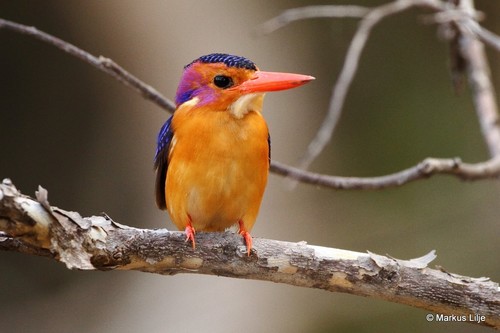
African Pygmy Kingfisher
Ispidina picta
The African Pygmy Kingfisher is a tiny, jewel-toned marvel of the African woodland. Though it carries the kingfisher name, this pint-sized hunter prefers chasing grasshoppers through gardens rather than fishing in streams.
Quick Identification
Size
Length: 11-13 cm (4.3-5.1 in); Weight: 9-16 g (0.3-0.6 oz); Wingspan: 18-20 cm (7-8 in)
Colors
Bright orange-rufous underparts and face, violet-wash on the ear coverts, deep blue upperparts with a lighter blue crown, and a brilliant red bill and legs.
Key Features
- Diminutive size, roughly the length of a smartphone
- Bright red, dagger-like bill and orange legs
- Violet-washed ear patches behind the eye
- Rich orange-rufous underparts and deep blue back
When You’ll See Them
Geographic range
Where Does the African Pygmy Kingfisher Live?
This vibrant gem is native to the vast landscapes of Sub-Saharan Africa, stretching from Senegal in the west across to Ethiopia and down into South Africa. It thrives across the equatorial belt in countries like Nigeria, the DRC, and Kenya, while populations in the northern and southern fringes are known to migrate toward the equator during the dry season. Whether in a coastal forest or a high-altitude woodland, this kingfisher is a common yet elusive resident across much of the continent's tropical and subtropical zones.
Basemap © OpenStreetMap contributors
Behavior
The African Pygmy Kingfisher is a solitary and territorial hunter, often seen perched motionless on a low branch before suddenly darting to the ground to snatch an insect. Unlike many of its relatives, this species is not tied to water; it is a woodland specialist that treats the forest floor as its primary hunting ground. Its flight is fast and direct, often appearing as a blue-and-orange blur as it zips through the undergrowth.
During the breeding season, these birds become more vocal and active, excavating tunnels in earth banks, road cuttings, or even abandoned termite mounds to create their nests. While they are generally shy, they have adapted remarkably well to mature suburban gardens that offer dense foliage and plenty of hunting perches.
EverydayEarth exclusive
Camera Tips
To capture the African Pygmy Kingfisher on an AI-powered camera, placement is everything. Since they are 'perch-and-pounce' hunters, look for horizontal, finger-thick branches roughly 1 to 2 meters (3 to 6 feet) off the ground that offer a clear view of an open patch of soil or short grass. Position your camera about 2 to 3 meters away from the perch, angled slightly upward to catch the vibrant colors of its chest and the distinct violet ear patch.
Because they are insectivores, traditional birdseed won't work to lure them. Instead, focus on areas with natural insect activity, such as near compost heaps or native flowering bushes that attract beetles and grasshoppers. Providing a small, shallow birdbath can also be a draw, as they do enjoy a quick dip to clean their feathers, even though they don't hunt in water.
Using a high-speed shutter or 'burst mode' on your camera is essential, as their movements are lightning-fast—one moment they are perfectly still, the next they are a blur of orange and blue. The best time for recording is during the first three hours of daylight and the two hours before sunset when lighting is soft and activity is at its peak. During the rainy season, watch for their arrival if you live in a migratory zone; they often return to the exact same territories and perches year after year.
Similar Species
Species that look similar or are commonly confused with African Pygmy Kingfisher.
Frequently Asked Questions
Record African Pygmy Kingfisher at your habitat
Connect a camera to start building your own species record — AI identifies every visitor automatically.