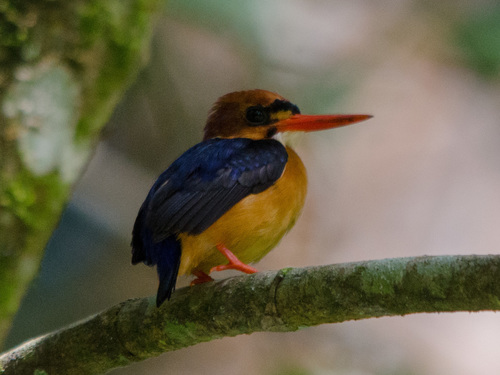
African Dwarf Kingfisher
Ispidina lecontei
The African Dwarf Kingfisher is the world's smallest kingfisher, a tiny crimson-billed gem that haunts the shadows of the African rainforest. Rare and remarkably secretive, it is a master of the forest understory.
Quick Identification
Size
Length 10 cm (4 in); Wingspan approx. 15-18 cm (6-7 in); Weight 9-12g (0.3-0.4 oz)
Colors
Deep ultramarine blue upperparts, rich rufous (orange-brown) underparts and face, black forehead, and a bright coral-red bill and legs. No significant sexual dimorphism.
Key Features
- World's smallest kingfisher
- Bright coral-red bill and legs
- Deep blue back with no light blue rump patch
- Blackish forehead crown
- Tiny, stocky silhouette with a very short tail
When You’ll See Them
Geographic range
Where Does the African Dwarf Kingfisher Live?
The African Dwarf Kingfisher is a jewel of the African tropical belt. It is native to the vast rainforests of West and Central Africa, with its core populations found throughout the Congo Basin and the Gulf of Guinea. Its range extends from Sierra Leone and Liberia in the west, through Nigeria and Gabon, reaching as far east as the lush forests of western Uganda and as far south as northern Angola.
Basemap © OpenStreetMap contributors
Behavior
The African Dwarf Kingfisher is a remarkably secretive and unobtrusive bird of the forest understory. Unlike many of its cousins, it is not primarily a fish-eater and is frequently found far from open water. It spends much of its day perched motionless on low branches or vines, usually within two meters of the ground, where it scans the leaf litter for movement. Its small size and dark plumage make it incredibly difficult to spot until it darts after prey with a sudden, blurring flight.
These kingfishers are generally solitary or found in pairs. They are highly territorial but rarely vocal, except for a high-pitched, thin 'tsip' call given in flight. While they are technically diurnal, they are most active in the dim light of dawn and dusk when their insect prey is most mobile. Interactions with humans are rare due to their preference for dense primary and secondary rainforests, though they may occasionally wander into mature, shaded suburban gardens located near forest edges.
EverydayEarth exclusive
Camera Tips
To capture the African Dwarf Kingfisher, camera placement is everything. Because these birds hunt in the lower strata of the forest, you should position your camera very low—ideally between 0.5 and 1 meter (1.5 to 3 feet) off the ground. Look for horizontal vines or thin branches that sit over open patches of leaf litter, as these are preferred hunting perches. If you have a shaded garden near a forest edge, placing a camera near a shallow, ground-level birdbath can yield excellent results, as they enjoy bathing in still water.
Since these birds are incredibly small and move with lightning speed, use a high-speed trigger setting. If your camera supports it, 4K video or a high-frame-rate 'burst' mode is essential to catch the moment they dive for an insect. Because they inhabit the dark understory, ensure your camera has a high-quality sensor for low-light conditions; otherwise, the images may appear grainy or motion-blurred in the forest gloom.
For baiting, these kingfishers are strictly insectivorous and won't be interested in seeds or fruit. A small, shallow tray of live mealworms placed in a dappled light clearing can entice them into your camera's field of view. Be sure to use 'No-Glow' or 'Black' infrared LEDs for nighttime or dawn/dusk monitoring, as standard red-glow LEDs might startle this high-strung species if it's roosting nearby.
Similar Species
Species that look similar or are commonly confused with African Dwarf Kingfisher.
Frequently Asked Questions
Record African Dwarf Kingfisher at your habitat
Connect a camera to start building your own species record — AI identifies every visitor automatically.