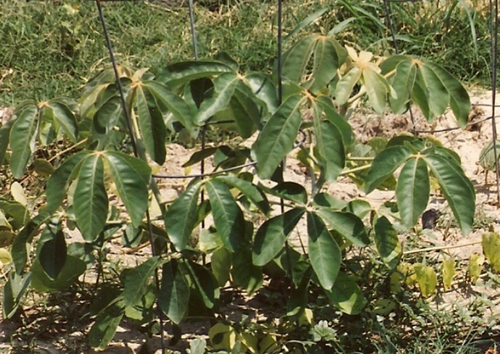
manketti-tree
Schinziophyton rautanenii
The lifeblood of the Kalahari sands, the Manketti tree is a resilient giant that provides food and shelter to an entire kingdom of wildlife. From its velvet-skinned fruit to its silver-grey bark, this iconic species is a masterpiece of desert survival.
Quick Identification
Size
15–20 meters (49–65 feet) in height; trunk diameter up to 1 meter (3.3 feet); canopy spread of 10–15 meters (33–49 feet)
Colors
Pale grey to golden-brown bark; dark green leaves with pale, velvet-textured undersides; greenish-yellow flowers; brownish-yellow ripened fruit
Key Features
- Palmate leaves with 5-7 leaflets and long stalks
- Smooth, silvery-grey bark that often appears iridescent
- Egg-shaped fruit (nuts) with a velvet-covered skin
- Wide, spreading crown that provides dense shade
When You’ll See Them
Behavior
The Manketti tree, also known as the Mongongo, is a resilient deciduous species perfectly adapted to the harsh, sandy environments of Southern Africa. It remains leafless for several months of the year to conserve water during the dry season, bursting into a lush canopy of hand-shaped leaves just before the rains arrive. This tree is a foundational pillar of its ecosystem, often growing in massive, healthy groves that dominate the crests of ancient sand dunes.
As a dioecious species, individual trees are either male or female, with the females producing the iconic Manketti nuts. These nuts are a vital resource, encased in a thick, hard shell that protects the nutrient-dense kernel for years. The tree's relationship with humans is ancient; it has been a staple food source for the San people for millennia, prized for its high oil content and durability. In the wild, it acts as a social hub, attracting a wide variety of animals that seek its shade and fruit.
EverydayEarth exclusive
Camera Tips
Capturing the Manketti tree on camera is less about the tree itself and more about the incredible biodiversity it attracts. To see the 'big hitters' like elephants or kudu, place your camera at chest height on a neighboring tree or a sturdy post about 5 to 7 meters (15-23 feet) away from the Manketti's trunk. During the fruiting season (April–May), the ground beneath a female tree becomes a high-traffic zone. Angle your camera slightly downward to catch elephants shaking the branches or smaller antelope foraging for fallen nuts.
If you are interested in the Manketti's avian visitors, such as Meyer’s Parrots or Grey Go-away-birds, consider a higher mounting point. A camera positioned 3-4 meters up a nearby branch, facing the mid-canopy during the flowering season in October, will yield spectacular shots of pollinators and fruit-eaters. Use a 'hybrid mode' if your camera supports it, capturing a high-resolution photo followed by a 15-second video to document the social interactions between birds competing for the blossoms.
Nighttime is a secret window into the Manketti’s world. Many nocturnal rodents and small carnivores visit the tree to scavenge. Set your PIR (passive infrared) sensor to high sensitivity and reduce the trigger interval to its shortest setting. This ensures you don't miss the quick movements of squirrels or nocturnal mammals trying to crack open the tough shells. For the best image quality, use a black-glow (no-glow) infrared flash so you don't spook the skittish nocturnal visitors that rely on the tree's protection.
Don't forget the power of time-lapse photography. The Manketti undergoes a dramatic transformation when it transitions from its stark, skeletal winter form to a lush green canopy. Set your camera to take one photo every 24 hours at mid-day for several months. When stitched together, this provides a mesmerizing look at the tree’s life cycle and the seasonal changes of the African savanna.
Similar Species
Species that look similar or are commonly confused with manketti-tree.
Frequently Asked Questions
Record manketti-tree at your habitat
Connect a camera to start building your own species record — AI identifies every visitor automatically.