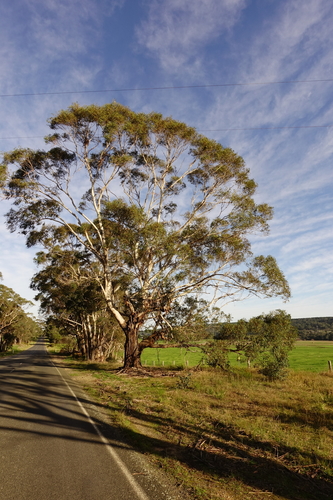
manna gum
Eucalyptus viminalis
The Manna Gum is the majestic 'ribbon gum' of the Australian bush, legendary as the Koala's favorite food and the source of sweet, sugary 'manna.' This towering evergreen is a wildlife magnet, providing essential habitat from its canopy to its ribbon-strewn roots.
Quick Identification
Size
Height: 10–50m (33–164ft), up to 90m (295ft); Trunk diameter: up to 2m (6.5ft)
Colors
Smooth white to cream-colored bark; dark green leaves; white filamentous flowers
Key Features
- Smooth white bark shedding in long, brown 'ribbons'
- Adult leaves are long, lance-shaped, and dark green
- Buds and fruit (gumnuts) usually found in clusters of three
- Produces sweet white flakes of 'manna' sap on the trunk and ground
When You’ll See Them
Geographic range
Where Does the manna gum Live?
The Manna Gum is native to the Australian continent, thriving in the cooler, high-rainfall regions of the southeast. Its core range encompasses much of Victoria, Tasmania, and New South Wales, extending into the southern parts of South Australia and reaching as far north as the New England Tableland in Queensland. It is a defining feature of temperate Australian woodlands and mountain forests, often found hugging creek lines in drier areas.
Basemap © OpenStreetMap contributors
Behavior
The Manna Gum is a fast-growing and ecologically vital evergreen tree known for its massive stature and shedding bark. It earns its name from the sweet, sugary white exudate (manna) that falls from its branches, especially after insect damage. This substance is a high-energy food source for a variety of insects, birds, and was traditionally harvested by Indigenous Australians.
Ecologically, these trees are a cornerstone species. They are the primary food source for koalas in southern Australia and provide critical nesting hollows for parrots, owls, and gliders as they age. The tree's habit of shedding long ribbons of bark creates a unique microhabitat at the base of the trunk, providing shelter for lizards, spiders, and ground-foraging mammals.
EverydayEarth exclusive
Camera Tips
For capturing the diverse wildlife that calls the Manna Gum home, camera placement is everything. To spot Koalas—the tree's most iconic resident—mount your camera on a nearby post or a sturdy branch about 3–5 meters high, angled toward the canopy's fresh growth. Manna Gums are the preferred food tree for Koalas in Victoria and South Australia, so a camera aimed at the foliage is highly likely to capture feeding behavior at night.
To document ground-dwelling visitors like Echidnas, Wombats, or lizards, place your camera 30–50cm above the ground, aimed at the base of the trunk. The pile of 'ribbon' bark that accumulates here is a magnet for foraging animals looking for invertebrates. The white trunk of the Manna Gum also serves as a brilliant high-contrast backdrop for night-vision (IR) photography, making animals pop against the bark.
If you are interested in birds or arboreal mammals like Sugar Gliders, focus your camera on the trunk where sap might be weeping or 'manna' has collected. During the flowering season (late summer), these areas become hotspots. Set your camera to a multi-shot burst mode or short video clips, as the movement of birds and gliders is often rapid. Use a high-sensitivity trigger to catch the subtle movements of nocturnal animals navigating the peeling bark.
Similar Species
Species that look similar or are commonly confused with manna gum.
Frequently Asked Questions
Record manna gum at your habitat
Connect a camera to start building your own species record — AI identifies every visitor automatically.