mountain grey gum
Trees Active day and night

mountain grey gum

Eucalyptus cypellocarpa

A towering icon of the Australian Great Dividing Range, the mountain grey gum is more than just a tree—it is a vertical highway for koalas and a nectar-rich oasis for rare birds.

0 Sightings
0 Habitats

Quick Identification

straighten

Size

A tall forest tree reaching 20–65 metres (65–213 feet) in height, with a trunk diameter often exceeding 1.5 metres (5 feet).

palette

Colors

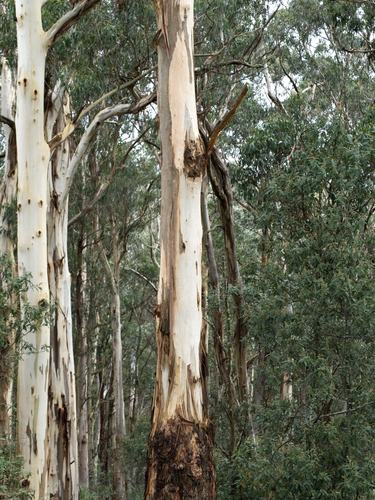
Smooth bark in shades of pale grey, cream, or yellowish-white, often with patches of weathered grey or brownish bark waiting to shed.

visibility

Key Features

  • Straight, tall trunk with smooth, mottled bark shedding in long ribbons
  • Large, glossy green lance-shaped leaves up to 35cm long
  • Flower buds arranged in clusters of seven with a conical or beaked operculum
  • Distinctive woody fruit shaped like small barrels or cylinders (gumnuts)
add_a_photo
Is this a mountain grey gum?

Drop a photo or video to find out instantly

When You’ll See Them

schedule
Activity pattern Active day and night
brightness_5
Peak hours 10 AM - 4 PM (Peak photosynthesis)
calendar_month
Season Year-round; flowering typically occurs from January to June.
restaurant
Diet As a plant, it produces its own energy through photosynthesis, requiring high light levels and deep, moist, well-drained loamy soils. It is a heavy consumer of groundwater, typically thriving in areas with high annual rainfall.
park
Habitat Primarily found in wet sclerophyll forests, deep mountain gullies, and on fertile slopes with high rainfall.

public Geographic range

Where Does the mountain grey gum Live?

The mountain grey gum is native to the southeastern corner of the Australian continent. Its core range extends along the Great Dividing Range and coastal foothills from the New England Tableland in New South Wales down through eastern Victoria, with a small, isolated population located in the Clarke Range of Central Queensland. It thrives in the cooler, high-rainfall zones of the south, where it often forms the backbone of mountain forest communities.

Basemap © OpenStreetMap contributors

1 Countries
280K km² Range
Least Concern Conservation
AU Australia
Marginal
eco
iNaturalist / Verified observation data
View on iNaturalist open_in_new

Explore more Trees arrow_forward

Behavior

The mountain grey gum is a sentinel of the Australian bush, known for its straight, towering stature and its role as a vital 'apartment complex' for local wildlife. It is frequently referred to as the 'monkey gum' because its smooth, pale bark often bears the distinctive horizontal scratch marks of climbing koalas, gliders, and lace monitors. Unlike many other eucalypts, this species maintains a very straight form, making it a dominant feature of the forest canopy where it competes for sunlight.

As a deciduous-bark tree, it undergoes a dramatic annual transformation where the outer layer of bark peels away in long, pendulous ribbons, revealing a fresh, creamy-yellow surface underneath. This shedding process isn't just for growth; it helps the tree rid itself of parasites and epiphytes. In a backyard or rural setting, a single mountain grey gum can define the local ecosystem, influencing the soil chemistry and providing a massive amount of nectar during its flowering season.

photo_camera EverydayEarth exclusive

Camera Tips

To capture the wildlife that frequents the mountain grey gum, mount your camera directly onto the trunk at a height of about 1.5 to 2 metres. Angle the camera slightly upward to capture the 'high-traffic' zone where arboreal mammals like the Sugar Glider or Koala climb. Because the bark is very light and reflective, use a camera with adjustable infrared flash intensity to avoid 'white-out' photos during night captures.

For ground-dwelling visitors, place the camera 5-10 metres away from the base of a mature tree. Wombats and Wallabies often use the massive root buttresses for shelter or as 'rubbing posts.' If you are using an AI-powered camera, set it to a wide-angle view to capture the movement of birds like the Yellow-tailed Black Cockatoo, which are frequently seen stripping bark in search of wood-boring larvae.

During the flowering months (late summer to autumn), consider using a 'canopy mount' or placing the camera on a high branch if accessible. This is the best time to record the frantic activity of honeyeaters and lorikeets. If the tree is shedding bark, be mindful that flapping ribbons of bark can trigger motion sensors; adjust your sensitivity settings to 'medium' to avoid hundreds of empty clips on windy days.

Frequently Asked Questions

While the tree itself is 'active' during daylight for photosynthesis, the wildlife it hosts is most active at two distinct times: nectar-feeding birds are busiest from dawn until mid-morning, while arboreal mammals like gliders and koalas are most active from dusk through the middle of the night.
You don't 'attract' the tree, but you can plant it if you have a large property with deep, fertile soil and high rainfall. Be aware that these trees grow exceptionally large and drop heavy limbs, so they are best suited for 'back-acreage' rather than small suburban yards near structures.
Mountain grey gums 'eat' sunlight, carbon dioxide, and water through photosynthesis. They are particularly fond of nutrient-rich, volcanic-derived soils or deep loams found in mountain gullies, where they can access consistent underground moisture.
They are uncommon in high-density suburban areas due to their massive size and the risk of falling limbs. However, they are very common in peri-urban 'acreage' suburbs and forest-fringe communities in Victoria and New South Wales.
Look at the fruit and the bark. The mountain grey gum has larger, barrel-shaped fruit and its bark sheds in long ribbons but usually remains smooth to the base, whereas the manna gum (E. viminalis) often has more persistent rough bark at the very bottom and smaller, more rounded fruit.

Record mountain grey gum at your habitat

Connect a camera to start building your own species record — AI identifies every visitor automatically.

Join free Identify a photo