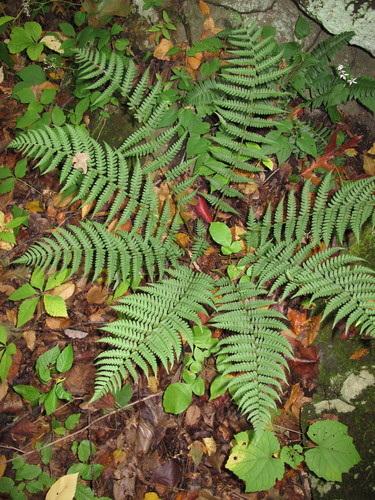
marginal wood fern
Dryopteris marginalis
A resilient evergreen anchor of the forest floor, the marginal wood fern is named for the unique placement of its spores along its leaf edges. Its sturdy, blue-green fronds provide vital winter shelter for backyard wildlife long after other plants have faded.
Quick Identification
Size
Height: 12-24 inches (30-60 cm); Spread: 18-24 inches (45-60 cm)
Colors
Deep blue-green or grayish-green fronds; undersides feature light brown to tan spore cases (sori); stems are covered in distinctive golden-brown scales.
Key Features
- Sori (spore clusters) located specifically along the margins of the leaflets
- Evergreen fronds that remain green throughout winter
- Sturdy, vase-like growth habit originating from a single central crown
When You’ll See Them
Behavior
The marginal wood fern is a non-aggressive, clumping perennial that serves as a foundational species in many eastern North American woodlands. Unlike many other fern species that spread rapidly via underground rhizomes, this fern grows slowly from a single point, creating a tidy, architectural 'vase' shape that makes it a favorite for woodland gardeners and wildlife alike.
In the wild, it acts as a resilient survivor, often found anchored in the crevices of rocky slopes or steep ravines where other plants cannot gain a foothold. During the winter months, while deciduous plants go dormant, the marginal wood fern’s fronds remain vibrant. They eventually lay flat against the ground under the weight of snow, providing essential thermal cover for small mammals, amphibians, and ground-foraging birds during the harshest months.
EverydayEarth exclusive
Camera Tips
Capturing the marginal wood fern on a backyard camera is less about 'catching' it in motion and more about documenting its fascinating life cycle and its interactions with nearby wildlife. To capture the most dramatic growth phase, set your camera to time-lapse mode in early spring (typically April or May). Position the camera at a low angle, about 6-10 inches from the ground, facing the central crown. You will be able to record the 'fiddleheads' or crosiers as they emerge and unfurl—a process that looks like a slow-motion alien awakening.
Because this fern is evergreen, it provides a perfect backdrop for a winter 'animal stage.' Place your camera 2-3 feet away from a healthy fern cluster during the winter months. Small mammals like shrews and voles, as well as ground-birds like Juncos, frequently visit these ferns for shelter. Set your camera to a high-sensitivity trigger or use a PIR (Passive Infrared) sensor to catch these quick movements against the green fronds, which provide excellent color contrast in a snowy or brown winter landscape.
For high-detail shots of the 'marginal' sori (the namesake spore cases), use a camera with a macro lens or a close-focus setting. The best time for this is late summer when the sori are fully developed and turn a rich cinnamon brown. If your camera allows for manual exposure, slightly underexpose the shot to emphasize the deep blue-green texture of the fronds without blowing out the highlights of the golden-brown scales on the stem.
Finally, consider the lighting. Marginal wood ferns thrive in dappled shade. Setting your camera to capture images during the 'golden hours' of early morning or late afternoon can create a beautiful backlighting effect through the fronds, highlighting the intricate, leathery texture of the foliage. In deep woods, use a camera with a good low-light sensor to avoid 'grainy' images caused by the heavy canopy overhead.
Similar Species
Species that look similar or are commonly confused with marginal wood fern.
Frequently Asked Questions
Record marginal wood fern at your habitat
Connect a camera to start building your own species record — AI identifies every visitor automatically.