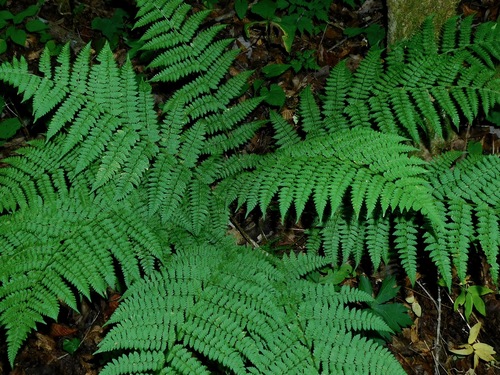
intermediate wood fern
Dryopteris intermedia
The intermediate wood fern is the 'lace' of the forest floor, offering delicate beauty and year-round green. A hardy survivor of the North American woods, it provides essential shelter for wildlife through every season.
Quick Identification
Size
Fronds typically range from 15 to 35 inches (40–90 cm) in length and 4 to 8 inches (10–20 cm) in width.
Colors
Deep rich green foliage; stems (stipes) are often tan or light brown and covered in pale scales.
Key Features
- Finely divided, lacy fronds with a 'tri-pinnate' appearance
- Tiny, sticky glandular hairs on the underside of the leaves and stems
- Evergreen fronds that stay green throughout winter
- Sori (spore cases) located midway between the leaf vein and the margin.
When You’ll See Them
Behavior
The intermediate wood fern is a resilient perennial that brings structural beauty to the forest floor. Known as a 'clump-forming' fern, it grows from a central crown, sending out fronds in a circular, vase-like arrangement. While many ferns wither and turn brown at the first sign of frost, this species is a true evergreen. Its fronds remain vibrant green through the winter, though they often lean flat against the ground under the weight of snow to protect the plant's core.
This fern plays a vital role in its ecosystem by providing year-round shelter for ground-dwelling wildlife. Small mammals and amphibians often use the dense, low-hanging fronds as cover from predators. In the spring, the plant begins its most active phase, sending up tightly coiled 'fiddleheads' that slowly unfurl into the delicate, lacy patterns that give the plant its 'fancy fern' nickname.
EverydayEarth exclusive
Camera Tips
Capturing the intermediate wood fern on camera requires a different strategy than mobile wildlife. Because these plants thrive in deep shade, your biggest hurdle is lighting. Use a camera with a high-quality sensor to handle low-light conditions without becoming grainy. If your AI camera supports time-lapse mode, position it about 18 inches from a new crown in early April. You can capture the mesmerizing 'slow-motion' unfurling of the fiddleheads, which is one of the most popular botanical events for nature enthusiasts.
To get the best identification shots, focus on the 'rachis' (the central stem). The presence of tiny, glandular hairs is a key identifier for this species, but they are very small. Set your camera to a macro or close-focus setting and ensure the lens is parallel to the frond to keep the entire leaf in the focal plane. Using a small reflector can help bounce natural light onto the underside of the frond to highlight the sori (spore cases) without the need for a harsh, artificial flash that might wash out the deep greens.
Since the intermediate wood fern provides excellent cover, it is a perfect 'secondary target' for your backyard camera. Place your camera at a low angle (3-5 inches off the ground) pointed toward the base of the fern. This 'ground-level' view is excellent for catching salamanders, wood frogs, or ovenbirds that use the fern's shadow for protection. The evergreen nature of the plant also makes it a fantastic subject for winter photography, providing a splash of color against the white snow when most other vegetation is dormant.
Similar Species
Species that look similar or are commonly confused with intermediate wood fern.
Marginal Wood Fern
The marginal wood fern has spore cases located right at the edge of the leaflets, and its fronds are less finely divided.
Spinulose Wood Fern
While very similar, the spinulose wood fern lacks the tiny glandular hairs on the leaf tissue and stems that characterize the intermediate wood fern.
Frequently Asked Questions
Record intermediate wood fern at your habitat
Connect a camera to start building your own species record — AI identifies every visitor automatically.