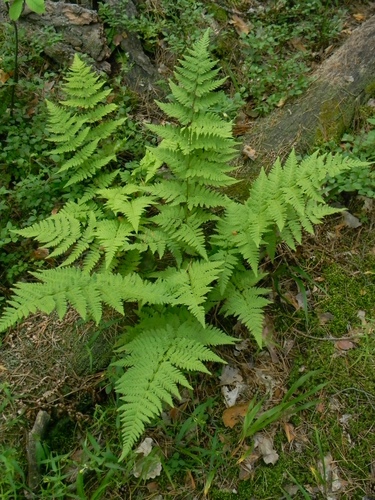
spinulose wood fern
Dryopteris carthusiana
A lacy, lime-green inhabitant of the forest's dampest corners, the spinulose wood fern is a master of the shade. Its delicate, spine-tipped fronds provide a year-round touch of elegance and vital shelter for the tiny creatures of the forest floor.
Quick Identification
Size
Fronds typically reach 1 to 3 feet (30–90 cm) in height and 4 to 10 inches (10–25 cm) in width.
Colors
Pale to medium yellowish-green fronds; stipes (stems) are tan with light brown scales at the base.
Key Features
- Finely divided, lacy fronds with spine-tipped (spinulose) teeth
- Lower-most leaflets (pinnae) are distinctly asymmetrical, with the bottom-facing side wider than the top
- Growth form is a symmetrical, vase-like crown radiating from a central point
- Round sori (spore cases) located on the underside of fertile fronds.
When You’ll See Them
Behavior
The spinulose wood fern is a hardy, semi-evergreen perennial that adds structural elegance to damp environments. Unlike many deciduous ferns that wither at the first sign of frost, this species maintains its vibrant green color well into the autumn and early winter. However, as temperatures drop significantly and snow accumulates, the fronds eventually collapse to the ground, though they often remain green beneath the leaf litter, providing critical insulation for the soil and small invertebrates.
As a non-flowering plant, its life cycle is dictated by moisture and light. In the spring, it undergoes a dramatic growth phase called circinate vernation, where tightly coiled "fiddleheads" emerge from the central crown and slowly unfurl. This species is relatively stationary but is highly responsive to its environment; it thrives in deep shade where other plants might falter, and its fronds will stand more erect during periods of high humidity to maximize spore dispersal.
EverydayEarth exclusive
Camera Tips
To capture the most compelling footage of a spinulose wood fern, focus on its transformation during the spring. Set up your camera on a low-profile tripod or a ground spike, positioning the lens roughly 12 to 18 inches from the central crown. Using a time-lapse setting—capturing one frame every 30 to 60 minutes—will allow you to document the incredible 'unfolding' of the fiddleheads over the course of a week. This is a unique way to use wildlife cameras to show the 'movement' of a plant that is otherwise perceived as still.
Lighting is the most critical factor for fern photography. Because these plants live in deep shade, a direct trail camera flash can often 'blow out' the delicate details of the fronds, leaving them looking flat and white. For the best results, use a camera with a high-quality CMOS sensor that performs well in low light without a flash. The soft, dappled light of the morning (between 7 AM and 10 AM) brings out the intricate textures of the pinnae and the yellowish-green hue that distinguishes this species from its darker cousins.
In the mid-to-late summer, try a macro approach. If your camera has a close-up focal range, aim it at the underside of the fronds. The sori (spore clusters) are geometrically fascinating and provide great educational content. Position the camera at a 45-degree upward angle to see the texture of the indusia (the membrane covering the spores). This angle also helps if you are hoping to catch 'secondary' wildlife action, such as tree frogs or salamanders that often use the cool, moist underside of the fern fronds for shelter during the heat of the day.
During the winter, don't move the camera. Even when the fern fronds have flattened against the ground, they provide a beautiful, textured green foreground for any winter wildlife passing by. A camera set at ground level will capture the contrast between the green fern and the white snow, making for excellent seasonal transition clips. No bait or lures are needed for the fern itself, but placing the camera near a naturally damp depression or log will ensure the fern stays healthy and attracts moisture-loving animals into the frame.
Similar Species
Species that look similar or are commonly confused with spinulose wood fern.
Frequently Asked Questions
Record spinulose wood fern at your habitat
Connect a camera to start building your own species record — AI identifies every visitor automatically.